


KEY TAKEAWAYS
Kosher food is food that has been prepared in accordance with Jewish dietary laws known as kashrut. The word ‘kosher’ comes from the Hebrew root meaning fit or proper. These laws govern which foods may be eaten, how animals must be slaughtered, which food combinations are permitted, and how food must be prepared and stored.
In the United Kingdom, where an estimated 280,000–350,000 Jewish people live, the majority concentrated in Greater London, Manchester, and a number of other communities, kosher food is a daily and weekly necessity for hundreds of thousands of families. It is also increasingly sought by non-Jewish consumers who value its quality standards, allergen clarity, and ethical production practices.
This guide covers everything you need to know about kosher food: the laws behind it, how to identify it, what the certification symbols mean, and where to buy it in the UK. Whether you are new to kosher food, curious about it, or building your knowledge of the community you serve, this is the most complete UK-focused resource available.
The Hebrew word kosher (כָּשֵׁר, also romanised as kasher) means fit, proper, or correct. In the context of food, it specifically describes food that is permissible under Jewish religious law — food that is suitable to be eaten by an observant Jewish person.
The system of laws governing what is and is not kosher is called kashrut (sometimes spelled kashrus). These laws have their origins in the Torah — the Five Books of Moses — and have been elaborated and codified over centuries in the Talmud and subsequent rabbinic literature. Today, kashrut is observed at varying levels of strictness by Jewish communities around the world, from minimal observance to mehadrin (ultra-strict) standards.
The opposite of kosher is treif (or treifa), a Yiddish word derived from the Hebrew for ‘torn’. A treif food is one that is not permissible under Jewish dietary law.
Kashrut covers a wide range of laws, but the most practically significant rules can be summarised as follows:
To be kosher, a land animal must have two characteristics: it must have completely split hooves, and it must chew its cud (regurgitate and re-chew its food). Animals that meet both criteria include cattle, sheep, goats, and deer. Animals that meet only one criterion — for example, the pig (split hooves but does not chew its cud) and the camel (chews its cud but does not have split hooves) — are not kosher. The pig is perhaps the most widely known non-kosher animal.
Fish must have both fins and scales to be kosher. This means that salmon, tuna, cod, haddock, and most common fish consumed in the UK are kosher. Seafood without fins and scales — including shrimp, prawns, lobster, crab, clams, oysters, and squid — is not kosher. Swordfish is a subject of rabbinical debate and is not accepted by most Orthodox communities.
The Torah lists 24 non-kosher bird species. In practice, the birds widely accepted as kosher in Jewish communities include chicken, turkey, duck, and goose. Birds of prey are not kosher. Because the exact identification of the 24 prohibited species is uncertain in some cases, custom plays a significant role in which birds are eaten by different communities.
All insects are forbidden under kosher law. This is why fresh produce — particularly leafy vegetables such as kale, spinach, and lettuce, as well as herbs, cauliflower, and broccoli — requires careful checking before use. Commercial kosher-certified products undergo inspection processes to ensure insect contamination is avoided.
One of the most distinctively practical aspects of keeping kosher is the complete separation of meat and dairy. This rule derives from the verse in the Torah: ‘You shall not boil a kid in its mother’s milk’, which appears three times, leading Jewish law to prohibit not just the cooking but the eating and any benefit from a mixture of meat and dairy.
In practice, this means:
Kosher food packaging reflects this: products are clearly labelled Meat (M), Dairy (D), or Pareve (P or DE – dairy equipment – if produced on shared equipment with dairy). Understanding these labels is essential for kosher households.
You can shop for some Kosher Meat products here: Click
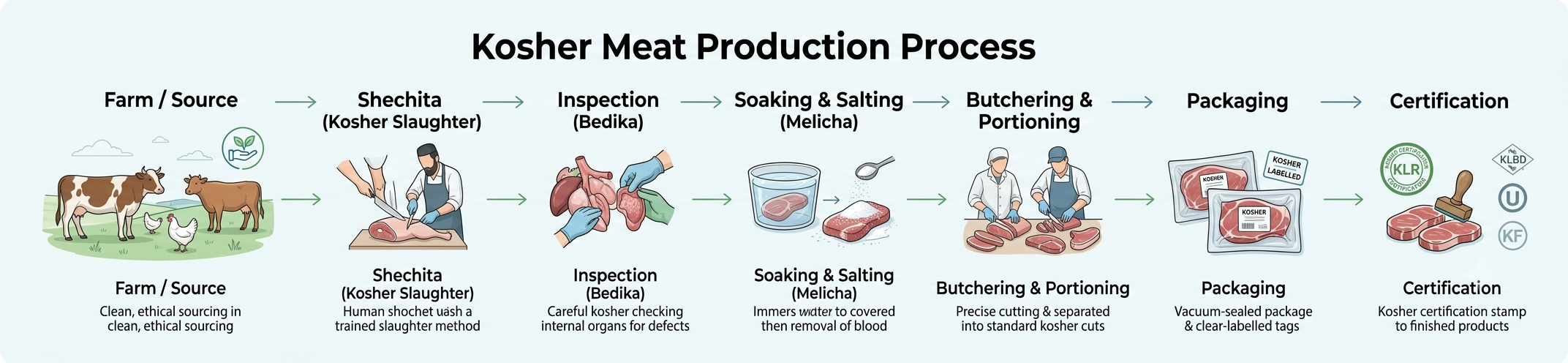
In a modern food supply chain, it is impossible for an individual consumer to verify the kashrut of every product they buy. This is where kosher certification plays a vital role. A kosher certification body employs trained inspectors (mashgichim) who audit food manufacturers, monitor production processes, check ingredient sourcing, and verify compliance with kosher law on an ongoing basis.
When a product passes this scrutiny, it is permitted to display the certification body’s symbol — called a hechsher — on its packaging. The presence of a hechsher tells the kosher consumer that the product has been independently verified as kosher. Different certification bodies are accepted at different levels of observance within the Jewish community; a mashgiach and a rabbi will often advise on which certifications their community recognises.
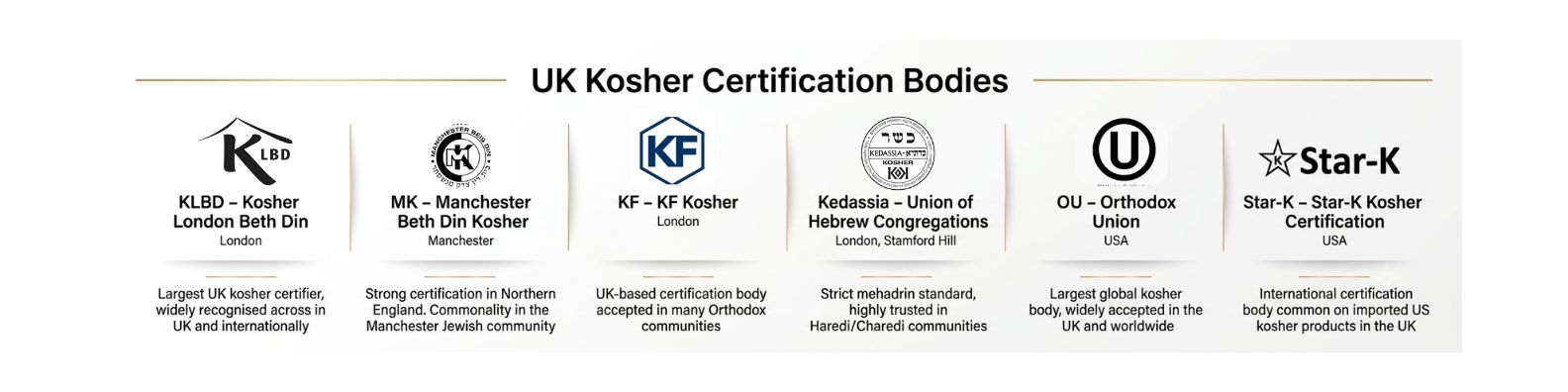
The principal kosher certification authorities operating in the United Kingdom are:
| Body | Full Name | Based In | Notes |
KLBD | Kosher London Beth Din | London | The largest and most widely recognised kosher certifying body in the UK. Certifies thousands of products from UK and international manufacturers. |
MK | Manchester Beth Din Kosher | Manchester | Recognised across Northern England. Certifies meat, bakery, and manufactured products in the Manchester Jewish community. |
KF | KF Kosher | London | Certifies a range of UK products and manufacturers. Widely accepted in UK Orthodox communities. |
Kedassia | Union of Orthodox Hebrew Congregations | London (Stamford Hill) | The strictest kosher certification standard in the UK, accepted by Charedi and Haredi communities. Kedassia products meet mehadrin standards. |
OU | Orthodox Union (USA) | International | The world’s largest kosher certification body. The OU symbol is widely accepted in the UK and globally. |
Star-K | Star-K Kosher Certification (USA) | International | Widely accepted internationally. Often found on US-imported kosher products sold in UK kosher stores. |
Kosher and halal are both religious dietary frameworks, and there are significant areas of overlap – both prohibit pork, both require specific methods of slaughter, and both involve religious supervision. However, there are important differences:
| Aspect | Kosher | Halal |
| Pork | Prohibited | Prohibited |
| Slaughter | Shechita – by a trained shochet, specific method | Dhabiha – must mention Allah’s name at slaughter |
| Meat-dairy separation | Strictly prohibited – never mixed | Not required |
| Shellfish | Prohibited (no fins and scales) | Generally permitted |
| Alcohol | Permitted under kosher law (with kosher certification for wine) | Prohibited entirely |
| Certification | By Jewish rabbinical bodies (KLBD, OU, etc.) | By Islamic certification bodies (HMC, HFA, etc.) |
It is worth noting that many kosher products are acceptable to Muslim consumers in the absence of halal-certified alternatives, but this is a personal religious decision. Kosher and halal certifications are not interchangeable. Browse our Kosher Meat range HERE
Kosher food is sometimes marketed with implicit health associations, and some aspects of kosher production do have genuine practical implications for food hygiene and quality. The removal of blood through the salting process, the strict inspection of animal lungs, and the prohibition on insects in produce all reflect standards that may differ from conventional food processing.
However, it would be misleading to claim that kosher food is categorically healthier than non-kosher food. Kosher food includes everything from fresh fish and lean meats to biscuits, confectionery, and processed foods. The kashrut laws are religious in nature — they were not designed as a dietary health framework, and they should not be presented as one.
What kosher certification does offer the health-conscious consumer is transparency: a certified kosher product has been inspected at source, its ingredients have been verified, and its production has been monitored by an independent authority. For consumers managing specific allergies — particularly those avoiding dairy — the clearly labelled kosher D (dairy), M (meat), and P (pareve) designations on packaging provide an additional layer of product clarity beyond standard allergen labelling.
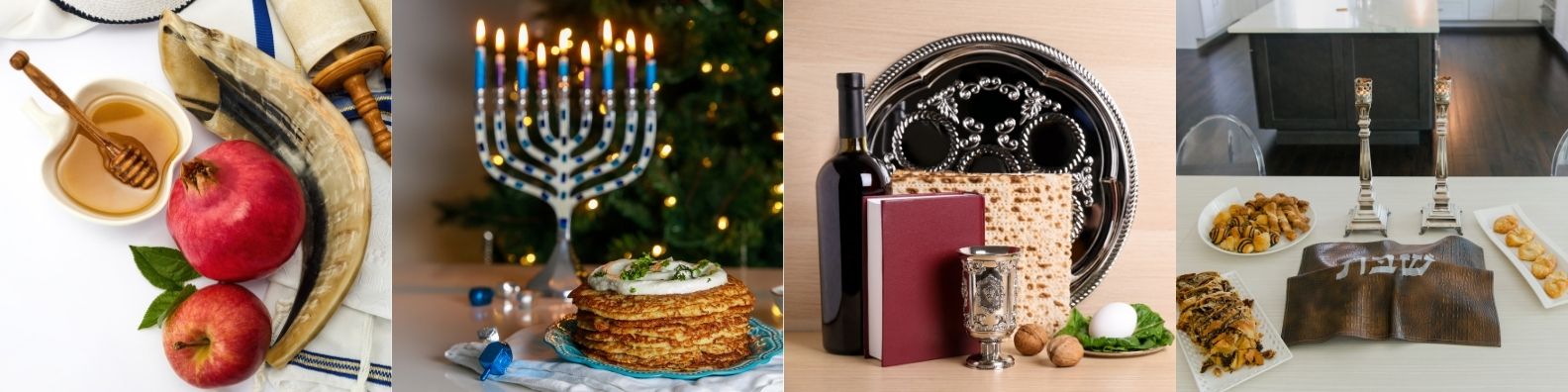
The Jewish calendar drives significant peaks in kosher food shopping throughout the year. Understanding these occasions helps explain why kosher food is so much more than a dietary restriction – it is a culinary expression of Jewish identity and community life.
Shabbat — the Jewish Sabbath observed from Friday sundown to Saturday night — is the most frequent and commercially significant kosher food occasion. Every week, Jewish families prepare a Shabbat table with challah (braided bread), chicken soup, roast chicken or beef, kugel, and desserts. Many families do not cook on Shabbat itself, which makes ready-prepared Shabbat food from a kosher supermarket essential. Sabeny’s Shabbat range includes fresh challah, prepared soups, meats, and desserts delivered before the Friday cut-off. Shop for Shabbat. Click here
Passover is the highest-spend period in the kosher food calendar. During the eight days of Pesach, all leavened grain products (chametz) are removed from the home, and only foods certified as kosher for Pesach are eaten. This creates a distinct shopping need: entirely separate Passover products are required for every category, from oils and condiments to biscuits and cereals. Families typically spend significantly more on food during Pesach than at any other time of year.
The Jewish New Year, celebrated in September or October, is marked by symbolic foods: apples dipped in honey (for a sweet new year), pomegranate, round challah, fish, and tzimmes (a sweet carrot dish). It is the second-highest spend period in the kosher food calendar after Pesach.
Hanukkah, the Festival of Lights celebrated in December, is associated with oil-fried foods — latkes (potato pancakes) and sufganiyot (jam doughnuts) — in commemoration of the miracle of the Temple oil. Hanukkah confectionery and gift foods are popular seasonal purchases.
Kosher food is available in the UK through several channels:
Sabeny’s nationwide delivery service means that wherever you live in the UK, the full range of kosher food is accessible. From a weekly Shabbat delivery to a full Pesach shop, Sabeny brings certified kosher food to your door.
Sabeny is the UK’s online kosher supermarket, delivering a full range of certified kosher food to homes across the country. Whether you are shopping for your weekly Shabbat essentials, preparing for Pesach, or stocking a kosher kitchen for the first time, Sabeny has everything you need.
Browse our full range: kosher meat, kosher bakery, kosher dairy, kosher deli, kosher grocery, and our weekly kosher outlet deals. Visit www.sabeny.com
Already have an account? Sign in
