

KEY TAKEAWAYS
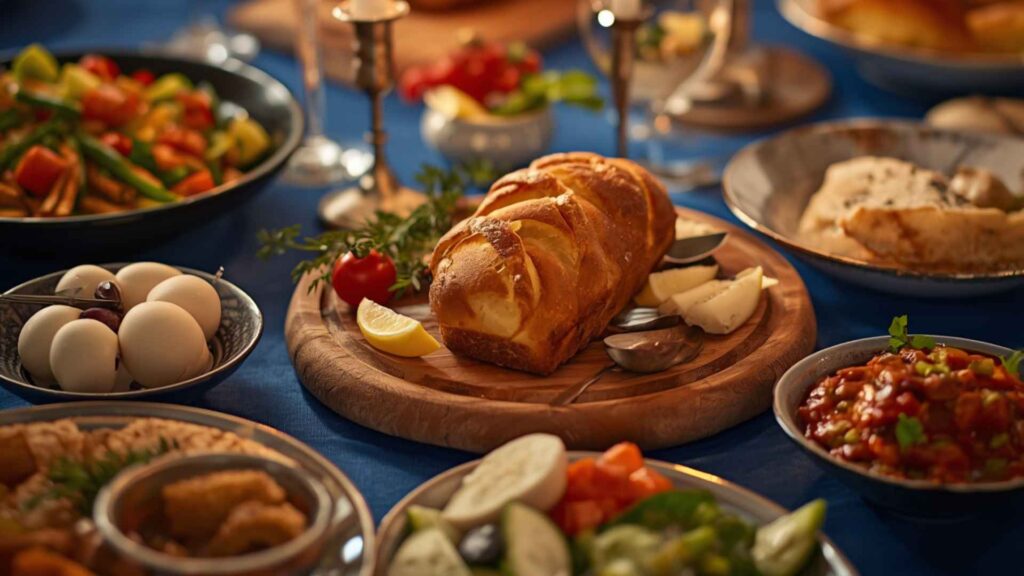
There is something particular about a Friday afternoon in a Jewish household. The kitchen has been active since morning. The smell of fresh challah has been drifting through the house since lunchtime. A pot of golden chicken soup bubbles quietly on the hob. The table is already set with a white cloth, the silver candlesticks polished, and two challot resting under their embroidered cover.
This is Shabbat, the Jewish Sabbath, and food is at its heart.
Shabbat food refers to the traditional dishes prepared and served for the Sabbath, observed from Friday sundown to Saturday night. The Friday night meal is the centrepiece: challah, chicken soup with kneidlach, a meat main course such as roast chicken or brisket, kugel, tzimmes, and a pareve dessert. Saturday lunch is anchored by cholent — the iconic slow-cooked stew that has been warming overnight — alongside cold cuts, salads, and baked goods. Between the two meals, Shabbat is the most food-rich occasion in the Jewish week.
For the 280,000–350,000 Jewish people living in the UK, Shabbat is not an occasional event but a weekly commitment. It is the most important regular kosher food purchase occasion of the year — more frequent than Pesach, more consistent than Rosh Hashanah, more commercially significant than any other moment in the kosher calendar. This guide covers everything you need to know: the traditional foods, the recipes, the planning, and where to buy everything you need for the perfect Shabbat table in the UK.
Shabbat (also called Shabbos in Ashkenazi pronunciation) is the Jewish day of rest, commanded in the Torah: ‘Remember the Sabbath day to keep it holy’ (Exodus 20:8). It begins at sunset on Friday evening and ends after nightfall on Saturday — marked by the appearance of three stars in the sky and the Havdalah ceremony.
Jewish law (halacha) prohibits 39 categories of creative work on Shabbat, including cooking. This means that all Shabbat food must be fully prepared before Shabbat begins. Far from being a constraint, this tradition has produced one of the most distinctive and beloved food cultures in the world: dishes designed to be made ahead, to hold their flavour overnight, to be served at room temperature or kept warm without active cooking. Challah, cholent, gefilte fish, kugel — these are not just foods. They are the edible architecture of Jewish weekly life.
The Torah also commands that Shabbat be honoured with three meals: Friday night dinner, Saturday lunch, and a third lighter meal (Seuda Shlishit) in the late Shabbat afternoon. Each meal begins with Kiddush — a blessing over kosher wine — and the Hamotzi blessing over the two challot.
Friday night dinner is the main event of the Shabbat week. It is the meal that gathers the family, welcomes guests, and marks the transition from a working week to a day of rest. The classic Ashkenazi Friday night dinner follows a well-established order of service:
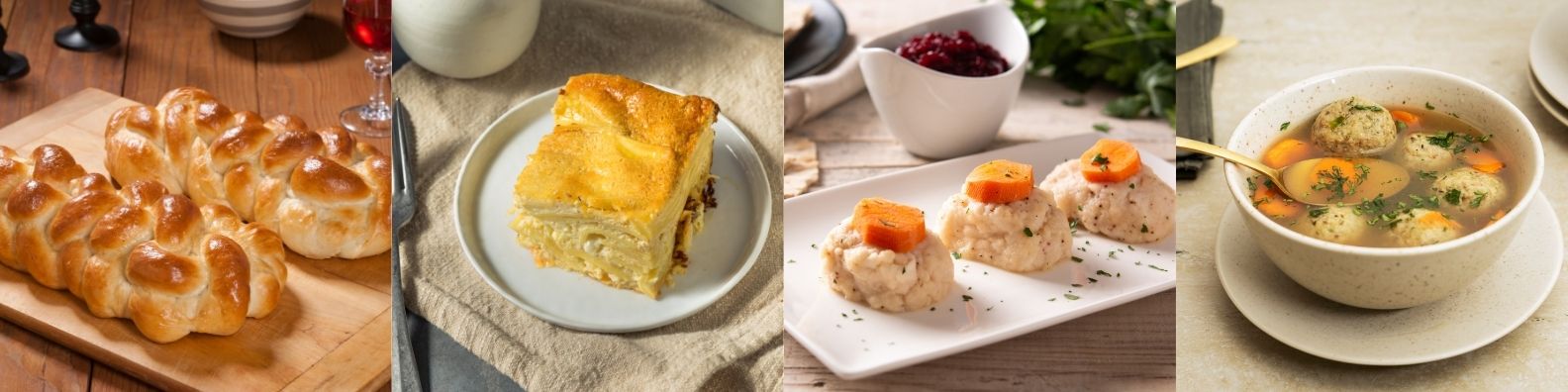
No Shabbat table is complete without two challot, the braided, egg-enriched loaves that are a symbol of Shabbat itself. The two loaves represent the double portion of manna that fell in the desert on Fridays during the Israelites’ 40 years of wandering (Exodus 16:22), ensuring they had enough food for Shabbat without having to gather on the holy day.
Challah is covered with an embroidered cloth until after Kiddush, when the covers are removed, the bread is blessed with the Hamotzi prayer, and slices are distributed around the table — often with a sprinkle of salt. Some families use round challot (particularly around Rosh Hashanah), challot topped with sesame or poppy seeds, or whole wheat challot. In Sephardi communities, the bread varies by regional tradition: Moroccan families may use a round, anise-flavoured bread; Yemenite communities use lahoh or other traditional breads.
Fresh challah is baked or delivered to arrive on Fridays. Sabeny’s kosher bakery delivers fresh challah across the UK with Thursday and Friday morning ordering options. Click here to shop challah bread
‘Jewish penicillin’ chicken soup is perhaps the single most iconic dish in Jewish food culture. At Shabbat, it serves as the first course of Friday night dinner, and it is almost universally present on Ashkenazi Shabbat tables across the UK.
The ideal Shabbat chicken soup is clear, golden, and deeply flavoured: a whole chicken simmered for hours with carrots, celery, onion, parsley, dill, and parsnip. The resulting broth is skimmed and clarified, served piping hot with kneidlach (matzah ball dumplings, soft or firm depending on family tradition), kreplach (triangular pasta dumplings filled with meat), or vermicelli noodles.
The soup must be prepared before Shabbat and kept warm on a blech (a metal sheet placed over the hob) or slow cooker to remain hot for serving. Sabeny stocks kosher chicken, soup vegetables, and prepared kneidlach mix for households who prefer a shortcut to homemade.
The Shabbat main course is a meat dish — typically roast chicken, slow-braised beef brisket, or a combination of both. Because it is a meat meal, all dishes served alongside it including dessert, must be kosher meat (fleishig) or pareve. Dairy is entirely excluded from the Friday night table in an observant home.
Roast chicken, rubbed with garlic, paprika, and olive oil, roasted until golden is the most common Shabbat main course in UK Ashkenazi households. Brisket, braised low and slow with onions, tomatoes, and carrots, is often served alongside or as an alternative for larger family gatherings. For families keeping fish-first traditions (common in many Sephardi and some Ashkenazi communities), gefilte fish or grilled salmon may precede or replace the chicken course.
Kugel is a baked casserole dish that has been a staple of Ashkenazi Jewish cooking for centuries. There are two main varieties: lokshen kugel (made with egg noodles) and potato kugel (made with grated potato). Both are baked in a deep dish until set and golden.
Lokshen kugel ranges from sweet (with cinnamon, raisins, and sugar) to savoury (with fried onions and black pepper). Potato kugel is almost always savoury, crispy on the outside, tender within. Jerusalem kugel (yerushalmi kugel) is a distinctive variety made with thin noodles, caramelised sugar, and black pepper that is famous throughout the Israeli-influenced British Jewish community.
Kugel is typically prepared on Thursday or Friday morning and reheated before serving. It is a side dish for Friday night dinner and a popular component of Shabbat kiddush spreads on Saturday.
Tzimmes is a sweet Ashkenazi stew made from carrots, dried fruit (prunes, raisins, apricots), and often meat, sweetened with honey and simmered until soft and caramelised. It is a traditional Friday night side dish — symbolically sweet for the Shabbat and associated with wishes for sweetness in the coming week. In Rosh Hashanah season, tzimmes takes on additional symbolic significance.
Other common Friday night side dishes include roasted vegetables, green beans with almonds, and various rice or potato dishes. The emphasis is always on food that can be prepared in full before Shabbat and served at the right temperature without active cooking.
Gefilte fish is a traditional Ashkenazi starter made from ground white fish,typically carp, pike, and whitefish — formed into oval patties and poached in fish stock. It is served cold or at room temperature, garnished with sliced cooked carrot and a generous dollop of chrain (horseradish sauce, either red or white).
Gefilte fish is the quintessential ‘prepared in advance’ Shabbat food: it is made before Shabbat begins, cooled, and served as needed throughout the weekend. Many UK Jewish households use jarred or frozen gefilte fish as a practical alternative to homemade. Sabeny stocks a range of prepared kosher gefilte fish suitable for all levels of observance.
It would be incomplete to discuss Shabbat food without noting that the Ashkenazi tradition above is one of several distinct Jewish culinary cultures celebrated on Shabbat. Sephardi and Mizrachi communities — whose families originated in Spain, North Africa, the Middle East, and beyond, have their own rich and distinct Shabbat food traditions.
Moroccan Shabbat tables include dafina (the Moroccan equivalent of cholent), pastilla (a sweet-savoury pastry), couscous with seven vegetables, and mechouia (roasted pepper and tomato salad). Iraqi Jewish families prepare tebit — a whole chicken stuffed with rice and spices, slow-cooked overnight. Yemenite families are known for their fragrant, cumin-spiced soup and lahoh bread. Persian Jewish households serve ghormeh sabzi and polo dishes alongside traditional challah.
Sabeny’s kosher range includes products suited to a wide variety of Sephardi and Mizrachi cooking traditions, including kosher spice blends, Israeli-sourced products, and a wide selection of pareve and kosher meat products.
While Friday night dinner receives the most attention, Shabbat lunch – served on Saturday after synagogue morning services – is a full meal in its own right, and for many families the more relaxed and social of the two Shabbat meals.
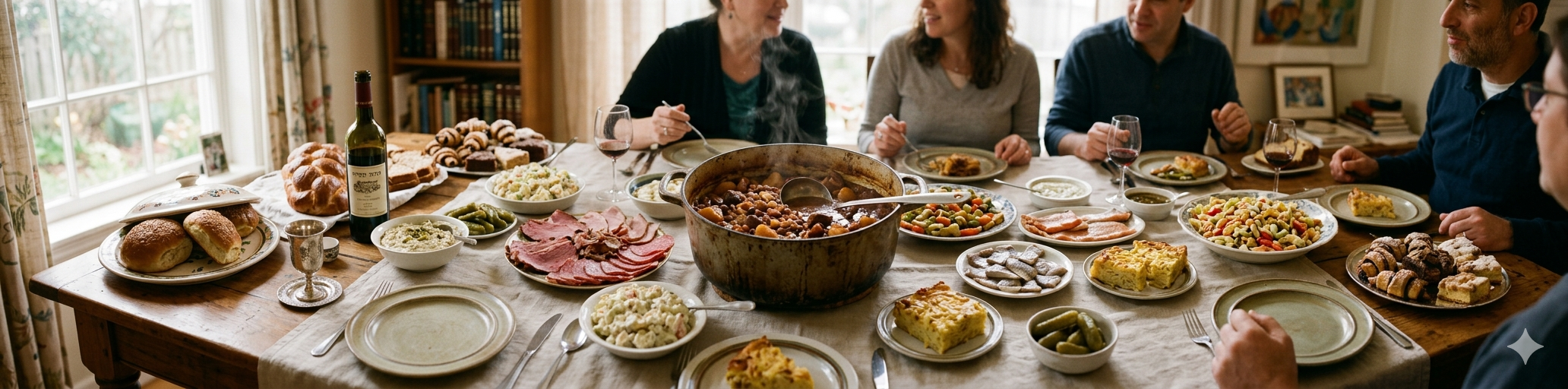
The centrepiece of Shabbat lunch is cholent (called chulent in some Ashkenazi communities, or hamin in Sephardi households). Cholent is a slow-cooked stew — typically beef, potatoes, beans, barley, onions, and kishke (stuffed derma), placed on a low heat before Shabbat begins on Friday evening and left to cook overnight. By Saturday lunchtime, the cholent has been cooking for 14–18 hours, becoming thick, rich, and deeply flavoured in a way that no other cooking method replicates. The pot is brought to the table in its entirety and served in generous portions.
Alongside cholent, Shabbat lunch typically includes cold cuts (sliced beef, pastrami, or salami), potato or pasta salads, kugel (often the same dish from the previous night, reheated), herring and smoked fish, and a spread of Shabbat cakes and baked goods. Many communities hold a communal Kiddush at the synagogue after morning services, a spread of foods available to the whole community, before families return home for their own Shabbat lunch.
Because the Friday night Shabbat meal is a meat meal, all desserts must be pareve — containing neither meat nor dairy. This requirement has given rise to one of the most inventive areas of Jewish baking.
Classic pareve Shabbat desserts include: fruit crumbles made with non-dairy margarine or coconut oil; pareve chocolate cake (made with oil instead of butter, and pareve chocolate chips); sorbet and fruit salads; pareve cheesecake alternatives; and apple strudel.
Shabbat cakes and baked goods are a category in their own right. Babka — a braided sweet bread filled with chocolate or cinnamon — has become perhaps the most internationally celebrated of all Jewish baked goods. Rugelach (crescent-shaped pastries filled with jam, chocolate, or cinnamon), mandelbrot (twice-baked biscotti), and kokosh cake (a rolled chocolate-filled cake) are staples of the Friday night dessert table. All should be either pareve or dairy, served at a dairy or pareve meal — never at the meat Friday night dinner unless pareve.
Sabeny’s kosher bakery range includes fresh challah, pareve cakes, babka, rugelach, and a full range of Shabbat baked goods available for UK delivery with a Friday morning cut-off.
Wine is central to Shabbat from beginning to end. Kiddush — the blessing that marks the beginning of Shabbat on Friday night and Saturday lunch, is recited over a cup of wine (or grape juice for children and non-drinkers). The wine must be kosher-certified.
For households with non-Jewish guests, or where the wine may be handled by non-Jews, mevushal kosher wine is recommended. Mevushal wine has been flash-pasteurised or heated to a specific temperature during production; once mevushal, the wine’s kosher status is not compromised if handled or poured by a non-Jew. This distinction is important for Shabbat hosting and for catered events.
Beyond Kiddush wine, Shabbat tables in UK Jewish homes include a range of beverages: Israeli wines, kosher Champagne for special occasions, sparkling grape juice, and soft drinks for children. The range of kosher wines available in the UK has expanded significantly in recent years, with excellent bottles now available from Israel, France, Spain, the United States, and South Africa. Sabeny stocks a curated range of kosher wines and grape juice suitable for Kiddush and Shabbat entertaining.
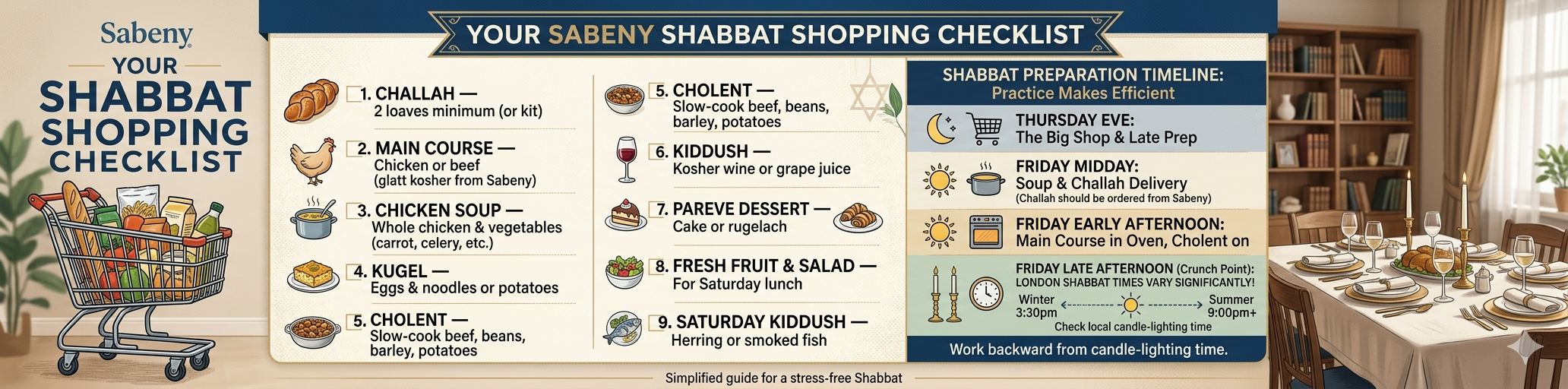
Shabbat preparation is a weekly discipline that most observant households manage with well-practised efficiency. For those new to Shabbat or setting up their first Shabbat home, the planning and shopping can feel significant at first. This checklist simplifies the process:
YOUR SHABBAT SHOPPING CHECKLIST
Most Shabbat preparation happens on Thursday evening and Friday morning. Chicken soup should be made by Friday midday to allow time for skimming and seasoning. The main course should be in the oven by early Friday afternoon. Cholent should be assembled and turned on Friday afternoon, well before Shabbat begins. Challah should be fresh — order from Sabeny for Friday morning delivery.
Friday afternoon is the crunch point. UK Shabbat times vary significantly: in winter, Shabbat can begin as early as 3:30pm in London, which means all food must be ready and the table set by mid-afternoon. In summer, London Shabbat times can be as late as 9:00pm or later, giving a more comfortable preparation window. Always check the Shabbat candle-lighting time for your local area.
Jewish food culture in the UK reflects the diverse origins of the community. The Ashkenazi tradition — rooted in Eastern European Jewish communities — dominates in large UK cities, particularly London and Manchester. But the UK also has significant Sephardi and Mizrachi communities, each with their own Shabbat food culture.
For Ashkenazi families, the core Shabbat menu is described above. For Sephardi families — including Moroccan, Iranian, Iraqi, Syrian, Turkish, and Israeli communities — Shabbat food is equally festive but distinctly different: fragrant rice dishes, slow-cooked lamb, North African spice blends, mezze-style salads, and community-specific bread traditions.
Sabeny’s range includes products relevant to both Ashkenazi and Sephardi cooking, including kosher spice blends, Middle Eastern staples, Israeli imports, and a wide range of pareve and meat products suitable for all Shabbat traditions.
When shopping for Shabbat, it is not sufficient for a product to simply carry a kosher symbol. Some Shabbat observers look for additional standards:
Sabeny’s product listings indicate kosher certification standards clearly, enabling customers to select products that meet their specific observance level. If you have questions about specific certification standards, contact Sabeny’s customer service team before ordering.
Shabbat is a time for hospitality — the Jewish concept of hachnasat orchim (welcoming guests) is central to Shabbat culture. Having guests at the Shabbat table, particularly those new to Jewish observance or from outside the community, is both a social and spiritual enrichment.
When entertaining for Shabbat, practical planning makes the difference between a relaxed and a stressful Friday evening:
For Jewish families across the UK, access to quality kosher food for Shabbat is a weekly necessity. In London and Manchester, physical kosher supermarkets and bakeries are within reach for most of the community. But for the significant and growing Jewish population in other UK cities — Birmingham, Leeds, Brighton, Edinburgh, Cardiff, and beyond — weekly Shabbat shopping from a specialist kosher supplier has not always been straightforward.
Sabeny delivers a complete Shabbat food range nationwide, including fresh challah, certified kosher meat and chicken, kosher wine and grape juice, prepared soups, kugel trays, bakery items, and grocery staples — everything on your Shabbat shopping list, delivered to your door.
Order by Thursday afternoon for Friday delivery. Sabeny’s cold chain packaging ensures that meat, fish, and fresh bakery items arrive in perfect condition, ready for Shabbat.
Whatever your Shabbat table looks like, from a simple family dinner to a full communal celebration, Sabeny has everything you need, certified kosher and delivered to your door. Fresh challah baked for Friday. Glatt kosher chicken and beef. Kiddush wine and grape juice. Pareve cakes and rugelach. Everything on your Shabbat list, with a Thursday ordering cut-off for Friday delivery nationwide. Click here to shop
Already have an account? Sign in
