

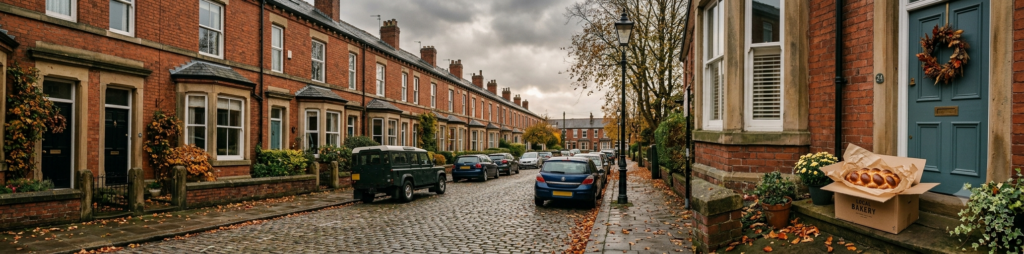
There is a version of British Jewish life that most people picture when they think of the UK Jewish community. Golders Green on a Friday afternoon. The bakeries on Brent Street. The queue outside the Grodzinski’s. The traffic on the North Circular as three thousand people simultaneously decide they need one more thing before Shabbat.
That version is real. It is also where about 140,000 of the UK’s 290,000 Jewish people actually live. The other 150,000 do not.
They live in Manchester and Salford, Leeds and Harrogate, Gateshead and Newcastle, Glasgow and Edinburgh, Birmingham and Solihull, Brighton and Hove, Bristol and Bath, Cambridge and Oxford, and in hundreds of smaller towns and villages across England, Scotland, and Wales where the nearest kosher shop might be an hour away, two hours away, or simply does not exist.
This post is for them. It is the honest account of what keeping kosher outside London actually involves in 2026 — the challenges, the communities, the compromises people make, and the ways things are genuinely getting better.

The UK Jewish community is concentrated in a way that shapes everything about kosher food access. The majority of British Jews live in a relatively small area of North West London — Golders Green, Hendon, Edgware, Finchley, Borehamwood, and surrounding suburbs. This concentration has produced a vibrant ecosystem of kosher shops, restaurants, bakeries, butchers, fishmongers, and delis that is, by any international standard, exceptional.
Step outside that ecosystem and the situation changes quickly. The further you travel from North West London, the sparser the kosher infrastructure becomes. Not uniformly – there are pockets of genuine density outside London – but the trend is unmistakeable.
Jewish community | Estimated Jewish population | Kosher infrastructure |
North West London (NW11, N3, HA8 etc) | ~140,000 | Dense: multiple supermarkets, butchers, bakeries, restaurants |
Manchester / Salford / Prestwich | ~30,000 | Substantial: kosher butchers, bakeries, some restaurants |
Gateshead | ~1,000 | Concentrated: strong Charedi community, dedicated suppliers |
Leeds | ~8,000 | Limited: a small number of kosher food options |
Glasgow / Giffnock | ~5,500 | Limited: one or two certified suppliers |
Birmingham / Solihull | ~6,500 | Very limited: minimal dedicated kosher retail |
Brighton / Hove | ~10,000 | Limited: some certified products in mainstream shops |
Bristol | ~2,000 | Very limited: largely dependent on online delivery |
Cambridge | ~2,000 | Very limited: university community, limited retail |
Edinburgh | ~1,000 | Minimal: almost entirely dependent on delivery |
Everywhere else | ~30,000+ | Varies: from near-zero to occasional certified products |
The phrase “limited kosher food access” is easy to write and hard to fully appreciate if you have grown up in or near North West London. Here is what it actually means in the daily life of a family keeping kosher in, say, Bristol.
It means that every supermarket run involves checking every single product for a kosher symbol. It means that the weekly challah — the bread that anchors Shabbat — either needs to be baked at home, brought back from a trip to London, or ordered online in advance and timed to arrive before Friday. It means that kosher meat requires either a trip that a Londoner would consider absurd for a food shop, or a monthly bulk order planned well in advance. It means that Rosh Hashanah round challah, which sells out in Golders Green by Wednesday before the holiday, requires even more forward planning. It means that the casual Friday afternoon “I forgot the grape juice” moment — entirely manageable in Hendon — is a genuine problem.
It also means that keeping kosher with any seriousness requires a level of organisation and planning that simply is not expected of Jewish families in North West London. The Londoner can forget things. The family in Edinburgh cannot.

The phrase “limited kosher food access” is easy to write and hard to fully appreciate if you have grown up in or near North West London. Here is what it actually means in the daily life of a family keeping kosher in, say, Bristol.
It means that every supermarket run involves checking every single product for a kosher symbol. It means that the weekly challah — the bread that anchors Shabbat — either needs to be baked at home, brought back from a trip to London, or ordered online in advance and timed to arrive before Friday. It means that kosher meat requires either a trip that a Londoner would consider absurd for a food shop, or a monthly bulk order planned well in advance. It means that Rosh Hashanah round challah, which sells out in Golders Green by Wednesday before the holiday, requires even more forward planning. It means that the casual Friday afternoon “I forgot the grape juice” moment — entirely manageable in Hendon — is a genuine problem.
It also means that keeping kosher with any seriousness requires a level of organisation and planning that simply is not expected of Jewish families in North West London. The Londoner can forget things. The family in Edinburgh cannot.
Manchester is the closest thing the UK has to a second London for kosher food infrastructure. The Jewish community is concentrated in Prestwich, Whitefield, Salford, and Broughton Park, and the kosher food ecosystem in those areas — while smaller than North West London — is genuinely substantial. There are certified kosher butchers, bakeries, a kosher supermarket, and a range of certified products available locally.
The Manchester Beth Din (MK) certifies kosher products across the region, and many Manchester-produced or Manchester-distributed products carry MK certification alongside or instead of KLBD. For strictly observant communities in Prestwich and Broughton Park — some of the most concentrated Charedi communities outside London — the kosher infrastructure is adequate for daily life.
The challenges emerge at the edges. Families in Didsbury, Chorlton, Altrincham, or Sale — outside the core Prestwich area — face a more significant gap. The commute to the kosher butcher becomes a deliberate trip rather than a convenient errand. And for Yom Tov shopping, when everyone in the community needs the same things at the same time, the local suppliers can be overwhelmed in a way that does not happen in Golders Green simply because of scale.
Gateshead is one of the most remarkable Jewish communities in the world relative to its size. A town of approximately 200,000 people in the North East of England has a concentrated Charedi Jewish community of around 1,000 people that maintains world-renowned yeshivot (rabbinical academies), a women’s seminary, and a kosher food infrastructure disproportionate to its population.
The Gateshead Jewish community is almost entirely Charedi and operates at the strictest level of kashrut observance. The community is largely self-sufficient in terms of Shabbat essentials — local butchers and certified suppliers serve the community’s needs. What it lacks is the variety and convenience of London. Specialty items, a wider range of products, and the sheer breadth of what London offers require either ordering online or a trip south.
Gateshead is also a reminder of something important: the quality of a Jewish community is not measured by the number of kosher restaurants nearby. Some of the most vibrant, observant, and cohesive Jewish life in the UK happens in places where the nearest Nando’s with a hechsher is four hours away.
Leeds has a significant Jewish community — approximately 8,000 people — concentrated in Moortown and Alwoodley in the north of the city. The community has a long history, an active synagogue life, and a dedicated Jewish community organisation. What it does not have is a fully stocked kosher supermarket. The limited local kosher retail means that most Leeds Jewish families rely on a combination of certified products from mainstream supermarkets, planned shopping trips to Manchester (approximately an hour away), and increasingly, online delivery.
Glasgow’s Jewish community is concentrated in Giffnock, on the south side of the city. Approximately 5,500 Jewish people, a number of active synagogues, and a community that has been part of Scottish life for well over a century. The kosher food situation is thin — a handful of certified suppliers and a significant dependence on online delivery for anything beyond the basics. The nearest substantial kosher shopping is effectively Manchester, four hours away by car.
Edinburgh, Bristol, Cambridge, Oxford, Brighton — each has a Jewish community, active synagogues, and Jewish families keeping kosher to varying degrees. Each is largely dependent on mainstream supermarkets for certified products and online delivery for everything else. For Yom Tov, the logistics get complicated fast.
Keeping kosher outside London is not impossible. Millions of Jewish people do it in cities around the world with far less infrastructure than Manchester or even Leeds. But it involves compromises that London-based Jews rarely have to make, and it is worth naming them honestly.
The honest picture is not all about limitation. Keeping kosher outside London is significantly easier in 2026 than it was ten years ago, and the primary reason is online delivery.
The growth of certified kosher online retailers has transformed the situation for communities outside London in a way that is genuinely difficult to overstate. A family in Edinburgh can now receive fresh challah, certified kosher meat, Israeli products, and Yom Tov essentials delivered to their door in a way that was simply not possible fifteen years ago. The monthly bulk meat order that used to require a trip to Manchester can now be delivered. The Rosh Hashanah preparation that used to mean a special trip south can now be handled online.
This is not a complete solution — there is no substitute for a local kosher butcher who knows your preferences, or a community bakery whose challah you have bought for twenty years. But it is a genuine, substantive improvement in the daily reality of keeping kosher outside London, and it is one that benefits the communities furthest from London the most.

Sabeny was built for the 150,000. Not exclusively — we deliver to London families too, and we are glad to — but the people who needed a solution most urgently were the ones for whom keeping kosher required a level of effort that London families never had to think about.
We deliver certified kosher food to every UK postcode. Manchester and Salford. Leeds and Harrogate. Gateshead and Newcastle. Glasgow and Edinburgh. Birmingham and Solihull. Brighton and Hove. Bristol and Bath. Cambridge and Oxford. Norfolk and Cornwall. The Scottish Highlands. Aberystwyth. Wherever you are keeping kosher in the UK, we can reach you.
Every product we stock is certified kosher under KLBD, Kedassia, or equivalent supervision. We are a Shomer Shabbat company — we do not operate on Shabbat or Yom Tov. We deliver Monday to Friday, with free delivery on orders over £85, and advance scheduling up to four weeks ahead for Yom Tov planning.
Sabeny delivers certified kosher food to every UK postcode — challah, meat, deli, grocery, and Yom Tov essentials. Free delivery over £85. Order at sabeny.com.
It is worth acknowledging that the experience described in this post — the challenges, the planning, the compromises — varies enormously depending on the level of kashrut observance in a given family or community. Not every Jewish family outside London keeps fully kosher. Some keep kosher at home but are more relaxed outside. Some buy certified products from supermarkets but do not use a kosher butcher. Some observe the laws in full with no compromise.
All of these are valid Jewish lives, and the challenges of keeping kosher outside London look different depending on where on that spectrum a family sits. This post has largely described the experience of families who keep kosher at home in the traditional Ashkenazi Orthodox sense. The experience of a family who keeps kosher more loosely is different — significantly easier in some respects, and shaped by different considerations.
What is consistent across all of them is the fundamental point: the infrastructure that London takes for granted does not exist outside London, and its absence shapes Jewish life in ways that are often invisible to those who have never had to think about it.
Sabeny stocks everything you need to keep a kosher kitchen — certified kosher meat, dairy, bakery, and grocery delivered to every UK postcode. Free delivery on orders over £85. Shop at sabeny.com.
Already have an account? Sign in
