

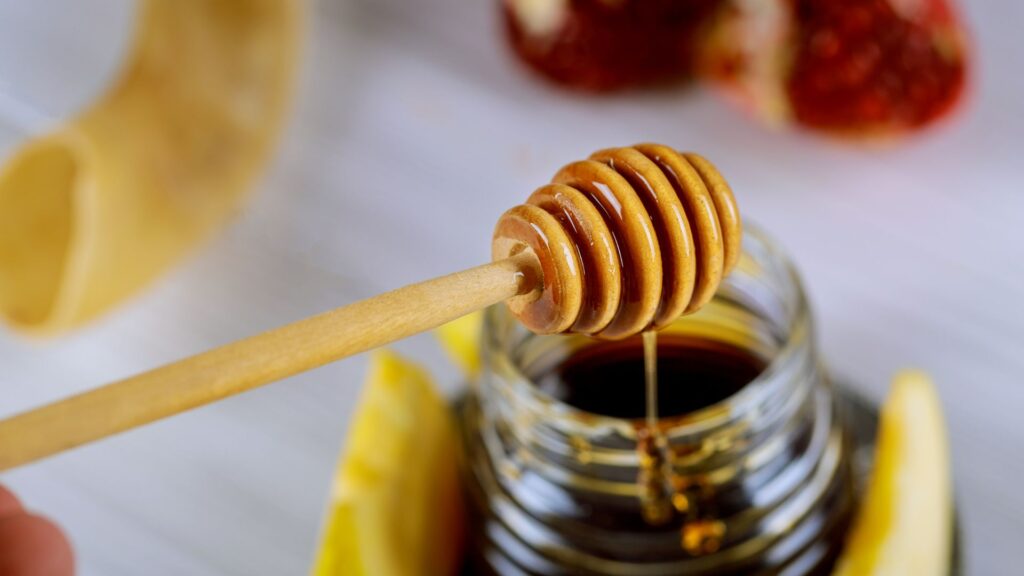
L’Shana Tova Umetuka — to a good and sweet new year, from everyone at Sabeny.
Every year, as Rosh Hashanah approaches, the same question comes up in offices, WhatsApp groups, and schools across the UK: what do you actually say? Is it Shana Tova or Shanah Tovah? Do you say it before, during, or after the holiday? And what on earth do you say back?
This guide covers everything — the meaning, the pronunciation, the full table of greetings, and how non-Jewish people can wish their Jewish friends a happy new year without putting a foot wrong.
What does Shana Tova mean?
The phrase Shana Tova (שנה טובה) is Hebrew for “a good year.” It is the most common Rosh Hashanah greeting used in Israel and throughout Jewish communities worldwide. The word shana means year, and tova means good -a short, warm, and direct wish for the twelve months ahead.
You will also see the greeting written as Shanah Tovah – the letter ה (heh) on the end is pronounced but is often dropped in casual spelling. Both are correct. In practice, Shana Tova is more commonly used in speech; Shanah Tovah appears more in formal written contexts such as cards and correspondence.
The full traditional greeting is Shana Tova Umetukah (שנה טובה ומתוקה) — meaning “a good and sweet new year.” The sweetness refers to the tradition of eating apples dipped in honey at the Rosh Hashanah table, symbolising hope for a sweet year ahead. When you see the full phrase written out on a Rosh Hashanah card, this is the version that is being used.
How to pronounce Shana Tova
Shana Tova is pronounced shah-NAH toe-VAH. The emphasis falls on the second syllable of each word. In spoken Hebrew the “ch” in Chanah would be the guttural sound, but Shana begins with a soft “sh” — like the English word “shine.”
The full version: sha-NAH toe-VAH oo-me-too-KAH. The oo in umetukah sounds like the oo in “moon” — not like “uh.”
The complete guide to Rosh Hashanah greetings
There is more than one Rosh Hashanah greeting, and which one you use depends on your community, how observant you are, and whether you are speaking Yiddish, Hebrew, or English. Here is the full table-
|
Greeting |
Language |
Transliteration |
Meaning |
When to use it |
|
שנה טובה |
Hebrew |
Shana Tova |
A good year |
The most universal. Use any time. |
|
שנה טובה ומתוקה |
Hebrew |
Shana Tova Umetukah |
A good and sweet new year |
Slightly more formal. Common on cards. |
|
שנה טובה |
Hebrew |
Shanah Tovah |
A good year |
Same meaning. More formal spelling. |
|
לשנה טובה |
Hebrew |
L’Shana Tova |
To a good year |
Short form. Casual spoken greeting. |
|
לשנה טובה תכתבו ותחתמו |
Hebrew |
L’Shana Tova Tikatevu |
May you be inscribed for a good year |
Used before Rosh Hashanah. The ‘books’ reference. |
|
גמר חתימה טובה |
Hebrew |
Gmar Chatima Tova |
A good final sealing |
Used between RH and Yom Kippur. |
|
א גוט יאר |
Yiddish |
A gut yor |
A good year |
Traditional Ashkenazi greeting. |
|
משיח בריגן |
Yiddish |
Mashiach bald |
May the Messiah come soon |
Traditional. More Charedi communities. |
What do you say back to Shana Tova?
The simplest reply is Shana Tova – just say it back. You can also reply Gam lecha (גם לך) meaning “to you also” -the Jewish equivalent of “and to you.” If someone says Shana Tova Umetukah, you can reply with the same phrase in full, or simply Gam lecha/Gam lachen (the feminine form).
Between Rosh Hashanah and Yom Kippur -during the Ten Days of Repentance -the greeting shifts to Gmar Chatima Tova (גמר חתימה טובה), meaning “a good final sealing,” referring to God’s final sealing of the Book of Life on Yom Kippur. After Yom Kippur ends, the greeting becomes Chag Sameach (חג שמח) for the remaining festivals of Sukkot and Shemini Atzeret.
When to say Shana Tova — before, during or after?
Shana Tova is primarily used in the period running up to and during Rosh Hashanah. You can begin using it from Rosh Chodesh Elul (approximately one month before Rosh Hashanah) all the way through the ten days until Yom Kippur. The greeting is most concentrated in the week before and during the two days of Rosh Hashanah itself.
After Rosh Hashanah passes and you are in the Ten Days of Repentance between Rosh Hashanah and Yom Kippur, switch to Gmar Chatima Tova as described above. You would not typically say Shana Tova to someone after Yom Kippur — by then the new year greeting period has passed.
Can non-Jewish people say Shana Tova?
Absolutely. Saying Shana Tova to a Jewish colleague, friend, or neighbour is a warm and appreciated gesture that will always be well received. You do not need to be Jewish to use the greeting — it is simply wishing someone a happy and sweet new year. Non-Jewish people in the UK often ask what to say because they want to get it right, and “Shana Tova” is always the correct, straightforward answer.
A simple “Shana Tova — have a meaningful Rosh Hashanah” covers all bases perfectly. If you want to acknowledge the High Holy Day season as a whole, you can follow up with “and an easy fast” for Yom Kippur (it is called an easy fast rather than a happy one because Yom Kippur is solemn rather than celebratory).
Is it “Happy Rosh Hashanah” or “Shana Tova”?
Both are used and both are fine. “Happy Rosh Hashanah” is the English equivalent — perfectly understood and warmly received, particularly from non-Jewish people. “Shana Tova” is the Hebrew greeting and the one Jewish people use among themselves. If you want to show a little more cultural awareness, Shana Tova is always appreciated over the English version, but “Happy Rosh Hashanah” is entirely correct.
One note: some strictly observant communities would consider Rosh Hashanah too serious a day to be called “happy” — it is a day of judgement, not just celebration. In those communities, L’Shana Tova Tikatevu (wishing someone to be inscribed in the Book of Life) carries more theological weight. For everyday use in the UK, “happy Rosh Hashanah” or “Shana Tova” are both entirely appropriate.
Shana Tova cards and gifts
Sending a Shana Tova card or gift is a meaningful way to mark the Jewish new year with friends, family, clients, or colleagues. In the UK, the tradition of sending Rosh Hashanah cards is well established — particularly among older generations — and is the Jewish equivalent of the Christmas card tradition.
Shana Tova cards typically feature imagery associated with the holiday — apples and honey, pomegranates, the shofar (ram’s horn), candles, and round challah. The greeting inside is usually Shana Tova Umetukah or the full blessing L’Shana Tova Tikatevu v’Techatemu — may you be inscribed and sealed for a good year.
Beyond cards, the tradition of sending food gifts at Rosh Hashanah is deeply embedded in Jewish culture. A Shana Tova hamper — filled with honey cake, round challah, wine, and festive foods — is a beautiful and practical way to mark the occasion. Whether you are sending to a host, a client, a family member in another city, or a Jewish friend whose traditions you want to honour, a curated kosher Rosh Hashanah gift says something cards alone cannot.
Sabeny’s Rosh Hashanah collection includes Shana Tova hampers, round challah, honey cake, festive wines, and everything you need for the Yom Tov table — certified kosher, delivered across the UK. Last delivery before Rosh Hashanah 2026: Thursday 10 September.
The Ten Days of Repentance — greetings between Rosh Hashanah and Yom Kippur
The period between Rosh Hashanah and Yom Kippur is known as the Aseret Yemei Teshuvah — the Ten Days of Repentance. During this time, the appropriate greeting shifts from Shana Tova to Gmar Chatima Tova (גמר חתימה טובה), meaning “may you be sealed for good.” This references the belief that on Rosh Hashanah God opens the Book of Life and begins judging each person, and on Yom Kippur the book is sealed. Between the two festivals, the outcome is still being determined — which is why the greeting becomes a prayer for a good sealing.
Immediately before Yom Kippur itself, many people say Tzom Kal (צום קל) – meaning “an easy fast” -as Yom Kippur is a 25-hour fast from sundown to nightfall. Wishing someone an easy fast is both kind and appropriate, whether you observe yourself or not.
More Articles:
When is Rosh Hashanah 2026? Dates, Meaning and Traditions UK
An insight into the Jewish festivals of Rosh Hashanah and Yom Kippur
Keywords:
shanah tovah | rosh hashanah greeting | happy new year in hebrew | happy rosh hashanah | shana tova greetings | jewish new year greeting | what is shana tova | rosh hashanah cards | jewish new year cards
Already have an account? Sign in
