
|
Event |
Date and Time |
|
Rosh Hashanah begins (Erev Rosh Hashanah) |
Sundown on Friday 11 September 2026 |
|
First day of Rosh Hashanah |
Saturday 12 September 2026 |
|
Second day of Rosh Hashanah |
Sunday 13 September 2026 |
|
Rosh Hashanah ends |
Nightfall on Sunday 13 September 2026 |
|
Hebrew date |
1st and 2nd Tishri 5787 |
|
Observed in Israel |
One day only — Saturday 12 September 2026 |
|
Observed in UK (Diaspora) |
Two days — Saturday 12 and Sunday 13 September 2026 |
In Israel, Rosh Hashanah is observed for one day. In the Diaspora — which includes all Jewish communities across the United Kingdom — Rosh Hashanah is observed for two full days. This is the halachic requirement for Jews living outside the Land of Israel, rooted in ancient practice when communities could not be certain of the exact date of the new month.
An important note for 2026: Rosh Hashanah this year begins on a Friday evening and the first day falls on Shabbat. This creates an extended three-day Yom Tov period, running from Friday evening through to Saturday night. For practical purposes — including food delivery — this means the final opportunity to receive orders before Rosh Hashanah is Thursday 10 September. There are no deliveries on Friday or Shabbat.
The name Rosh Hashanah comes from two Hebrew words: rosh, meaning head, and shanah, meaning year. Together they mean the head of the year — or in plain English, the Jewish New Year. It marks the first day of the Hebrew month of Tishri, which in 2026 falls on 11 September in the secular calendar.
But the meaning of Rosh Hashanah goes far deeper than a date on the calendar. In Jewish theology and tradition, Rosh Hashanah is Yom HaDin — the Day of Judgement. It is the day on which, according to Jewish belief, God opens the heavenly books and every person is judged for the deeds of the year that has just passed. The image from the High Holy Day liturgy is powerful: people are written into the Book of Life or the Book of Death, with the final verdict sealed ten days later on Yom Kippur.
This combination of celebration and solemnity is what makes Rosh Hashanah unique among Jewish festivals. Unlike most holidays, it is not primarily about historical events or agricultural cycles — it is about the relationship between God and every individual human being. It is at once the most universal and the most personal of Jewish observances.
Rosh Hashanah marks the beginning of the Jewish lunar calendar year. In 2026, it ushers in the year 5787 — the number of years since the biblical date of creation according to Jewish tradition. Unlike the secular 1 January new year, Rosh Hashanah is observed with synagogue services, festive meals, and the blowing of the shofar, rather than parties and fireworks. It is a time of reflection, family, and the renewal of commitment to living a meaningful life.
Rosh Hashanah is known by several names in the Torah and Jewish tradition, each reflecting a different dimension of the festival:
|
Hebrew Name |
English Meaning |
Significance |
|
Rosh Hashanah |
Head of the Year |
The most common name — marks the new year of the Jewish calendar |
|
Yom Teruah |
Day of Sounding the Shofar |
The biblical name, from Numbers 29:1 — the shofar is the central mitzvah |
|
Yom HaDin |
Day of Judgement |
Reflects the theological significance — God judges all people on this day |
|
Yom HaZikaron |
Day of Remembrance |
God remembers the deeds of all people — and the covenant with the Jewish people |
|
Yom HaKeseh |
Day of Concealment |
Refers to Rosh Hashanah falling on the new moon, when the moon is hidden |
Rosh Hashanah has its origins in the Torah, where it is commanded in the book of Leviticus (23:23-25) and Numbers (29:1-6). The Torah commands the Jewish people to observe the first day of Tishri as a sacred day of rest, marked by the blowing of the shofar – though it does not explicitly name it as the new year. The designation of this day as the Jewish new year developed over time in Rabbinic tradition.
The festival takes on its full theological character in Rabbinic Judaism, where the themes of creation, judgement, and the relationship between God and humanity are woven together into the rich liturgy of the High Holy Days. The central prayer of the Rosh Hashanah service — Unetaneh Tokef, composed in its current form in the medieval period — speaks of God as the great judge who on Rosh Hashanah writes and on Yom Kippur seals every person’s fate for the coming year. It is one of the most powerful and moving texts in all of Jewish prayer.
The Talmud records a debate about when the world was created — some sages held it was on the 25th of Elul, with the creation of humanity completed on Rosh Hashanah, while others held Rosh Hashanah itself was the first day of creation. Both views place Rosh Hashanah at the very beginning of human existence, giving the festival its character as a day of cosmic significance.
Rosh Hashanah 2026 marks the beginning of the Hebrew year 5787. This count represents the years since the traditional Jewish date of creation — a figure calculated through the genealogies and chronologies of the Torah. While modern scholarship approaches the age of the universe very differently, the Jewish year count carries profound symbolic weight and is used in halachic (Jewish legal) contexts worldwide, from synagogue records to Jewish marriage certificates.
Rosh Hashanah is one of the most richly observed festivals in the Jewish calendar, with distinctive customs and practices observed by Jewish communities across the UK and around the world. Here is what Rosh Hashanah looks and feels like for British Jewish families:
The single defining mitzvah of Rosh Hashanah is hearing the shofar — a ram’s horn that is blown in the synagogue on both days of the festival. The Torah explicitly commands Yom Teruah, a day of sounding, and the shofar fulfils this commandment.
In synagogue services, the shofar is sounded 100 times in a specific sequence of calls. There are four types of shofar sounds:
The sound of the shofar is unlike anything else in Jewish life. Even for those who are not deeply observant, hearing the shofar on Rosh Hashanah is a profound moment – a sound that connects the present to thousands of years of Jewish history, from the ram caught in the thicket at the Akeidah to the synagogues of Golders Green, Gateshead, and Glasgow today.
Rosh Hashanah synagogue services are among the most attended of the entire Jewish year. Many Jewish people who do not attend synagogue regularly throughout the year come for Rosh Hashanah- the High Holy Days represent the spiritual heartbeat of the Jewish calendar.
The Rosh Hashanah Machzor (the special High Holy Day prayer book) contains prayers and liturgical poetry that are unique to this period. The Musaf (additional) service on Rosh Hashanah is structured around three central themes, each with its own section of prayers and shofar blowing: Malchuyot (God’s sovereignty), Zichronot (remembrance), and Shofarot (revelation). The service can last several hours, and the atmosphere in synagogue on Rosh Hashanah morning – particularly during the shofar blowing – is unlike any other day in the Jewish year.
On the afternoon of the first day of Rosh Hashanah (or the second day if the first falls on Shabbat, as it does in 2026), Jewish families across the UK observe the custom of Tashlich. Families walk to a body of running water – a river, pond, or stream – and symbolically cast their sins into the water, often by throwing breadcrumbs or emptying their pockets.
The custom is based on a verse from the book of Micah: ‘You will cast all their sins into the depths of the sea.’ In 2026, because the first day of Rosh Hashanah is Shabbat, Tashlich is performed on the second day — Sunday 13 September. In London, the ponds of Hampstead Heath and the rivers and parks across Jewish north London are popular Tashlich destinations.
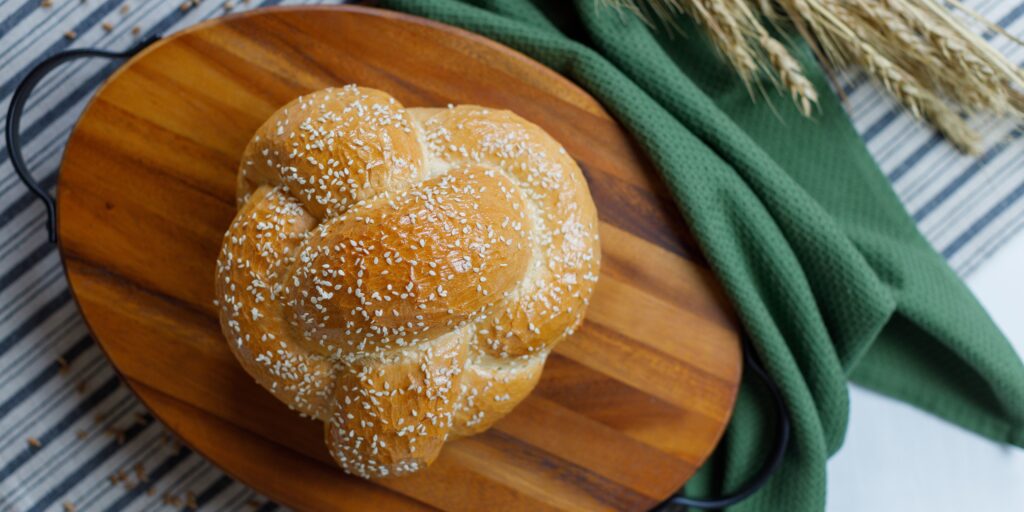
The meals on both evenings and both days of Rosh Hashanah are among the most joyful and meaningful in the Jewish year. The table is set with specific traditional foods, each carrying symbolic significance. The Rosh Hashanah meal begins with Kiddush over wine, the washing of hands, and the blessing over the round challah — followed by a series of simanim, symbolic foods eaten with special blessings.
The Rosh Hashanah table is one of the most distinctive in the Jewish calendar. Round challah replaces the usual braided loaf. Honey cake is the traditional dessert. The apples and honey are passed around before the meal begins. For British Jewish families, the Rosh Hashanah table is a time to gather generations together, to pass traditions from parents to children, and to sit together at the turn of a new year.
The eating of simanim — symbolic foods accompanied by short prayers expressing hope for the new year — is one of the most distinctive and beautiful Rosh Hashanah customs. Different communities have different traditions, but the most common simanim include:
|
Food (Siman) |
Hebrew Prayer (abbreviated) |
What It Symbolises |
|
Apple dipped in honey |
May it be Your will to renew for us a good and sweet year |
Sweetness and hope for the year ahead |
|
Round challah dipped in honey |
Standard hamotzi blessing |
The circular shape symbolises the cycle of the year and the crown of God |
|
Pomegranate |
May our merits be as numerous as the seeds of the pomegranate |
Abundance of good deeds — traditionally said to have 613 seeds, matching the 613 commandments |
|
Fish head (or lamb’s head) |
May we be like a head and not a tail |
Leadership, going forward not backward |
|
Dates (tamar) |
May those who hate us be consumed (tamru) |
A pun in Hebrew — the word for dates sounds like the word for ‘consumed’ |
|
Carrots (in Yiddish: merin) |
May our merits increase (merin) |
Another Hebrew/Yiddish wordplay — increase and renewal |
|
Beets (silka) |
May our adversaries be removed (yistalku) |
Again a wordplay — beets and removal share similar sounds in Aramaic |
Not every family observes all the simanim ~ but apples and honey, pomegranate, and round challah are virtually universal in British Jewish homes at Rosh Hashanah.
KEYWORD NOTE: when does rosh hashanah end | rosh hashanah dates
In the UK, Rosh Hashanah 2026 ends at nightfall on Sunday 13 September 2026, when three medium-sized stars become visible in the night sky, marking the formal conclusion of Yom Tov. The precise time varies by location; in London this will be approximately 8:15pm on 13 September, slightly later further north.
In Israel and for those who observe one day, Rosh Hashanah 2026 ends at nightfall on Saturday 12 September 2026.
Rosh Hashanah does not stand alone – it is the beginning of an extended period of spiritual intensity in the Jewish calendar. The ten days between Rosh Hashanah (1 Tishri) and Yom Kippur (10 Tishri) are known as the Aseret Yemei Teshuvah, the Ten Days of Repentance. During this period, Jewish tradition teaches that the heavenly books remain open – written on Rosh Hashanah but not yet sealed – giving every person the opportunity to change the divine verdict through repentance, prayer, and acts of charity.
The Shabbat that falls within these ten days is known as Shabbat Shuva, the Shabbat of Return, a particularly significant and spiritually charged Shabbat when many rabbis deliver their most important sermons of the year. In 2026, Shabbat Shuva falls on 19 September.
Yom Kippur — the Day of Atonement, the most solemn day in the Jewish calendar — follows Rosh Hashanah ten days later. In 2026, Yom Kippur begins at sundown on Sunday 20 September and ends at nightfall on Monday 21 September. It is marked by a 25-hour fast, five synagogue services, and the final sealing of the heavenly books.
For those ordering break fast food for Yom Kippur from Sabeny — the last delivery before Yom Kippur is Friday 18 September 2026. Plan your break fast order in advance.
Jewish communities across the United Kingdom observe Rosh Hashanah with the full two-day festival. From the large communities in London, Manchester, and Leeds to the deeply Torah-observant community in Gateshead, and smaller but thriving communities in Birmingham, Brighton, Glasgow, Bristol, Cambridge, and beyond — Rosh Hashanah is the most widely observed Jewish festival in British Jewish life.
London is home to approximately 140,000 Jewish people, with the largest concentrations in the areas of Golders Green, Hendon, Stanmore, Edgware, Borehamwood, and Stamford Hill. Each of these communities has its own synagogues, character, and customs — from the Ashkenazi shuls of Golders Green to the Charedi (strictly Orthodox) communities of Stamford Hill, where Rosh Hashanah is observed with particular intensity.
In London Jewish communities, the period before Rosh Hashanah is one of the busiest times of year for kosher shops and suppliers. Round challah and honey cake are in high demand in the weeks before the festival, and local kosher bakeries often sell out days before Yom Tov. Ordering in advance through Sabeny guarantees you get what you need regardless of local stock.
Candle lighting time in London on Friday 11 September 2026: approximately 7:10pm.
Manchester has one of the largest and most vibrant Jewish communities outside London, centred in Prestwich, Whitefield, and Salford. The community is well-served by local institutions, synagogues, and communal infrastructure. Rosh Hashanah in Manchester is observed with large synagogue services and warm community gatherings.
Manchester’s Jewish community has grown significantly in recent decades, with many London families relocating. For Rosh Hashanah food, many Manchester families use online delivery to supplement local availability, particularly for a wider range of specialty items.
Candle lighting time in Manchester on Friday 11 September 2026: approximately 7:28pm.
The Gateshead Jewish community is one of the most remarkable in the UK — a deeply Torah-observant community that has maintained its character and strength for generations. Gateshead is home to one of the most prestigious yeshivos (Torah academies) in the world, and the community observes Rosh Hashanah with a seriousness and intensity that reflects its ethos.
For Gateshead families, access to a wide range of kosher Rosh Hashanah products has historically required travelling or relying on limited local options. Sabeny’s nationwide delivery changes this — bringing the full Rosh Hashanah collection to Gateshead doorsteps with the same reliability as London.
Candle lighting time in Gateshead on Friday 11 September 2026: approximately 7:38pm.
Jewish communities across Leeds, Birmingham, Glasgow, Brighton, Bristol, Cambridge, and many smaller UK towns observe Rosh Hashanah with the same care and tradition as the larger centres. For these communities, the challenge of accessing a full range of kosher Rosh Hashanah products – round challah, honey cake, simanim, quality festive meals – is a real and annual one.
Sabeny delivers to every postcode in England, Scotland, and Wales, which means that a Jewish family in Glasgow, Bristol, or Cambridge has exactly the same access to their Rosh Hashanah essentials as a family in Golders Green. That is what we were built to do.
Yom Tov candles are lit before sunset on the evening that Rosh Hashanah begins. In 2026 this is the evening of Friday 11 September — which is also Erev Shabbat. Because Rosh Hashanah begins on Friday, candle lighting follows the same rules as Erev Shabbat: candles must be lit at the published candle lighting time, not after.
The following are approximate candle lighting times for Friday 11 September 2026 in major UK cities. These are based on 18 minutes before sunset for each location. Always verify with your local synagogue or a reliable halachic calendar such as myzmanim.com or hebcal.com for the exact time in your area.
|
City |
Candle Lighting (approx) Fri 11 Sep 2026 |
Havdalah (approx) Sun 13 Sep 2026 |
Community |
|
London |
7:10pm |
8:15pm |
Golders Green, Hendon, Stamford Hill, Edgware, Borehamwood |
|
Manchester |
7:28pm |
8:35pm |
Prestwich, Whitefield, Salford |
|
Leeds |
7:26pm |
8:33pm |
Moortown, Alwoodley, Roundhay |
|
Birmingham |
7:20pm |
8:24pm |
Edgbaston, Solihull, Sutton Coldfield |
|
Glasgow |
7:52pm |
9:02pm |
Giffnock, Newton Mearns, Pollokshields |
|
Gateshead |
7:38pm |
8:45pm |
Gateshead town centre |
|
Brighton |
7:14pm |
8:17pm |
Hove, Kemp Town |
|
Edinburgh |
7:57pm |
9:08pm |
Newington, Morningside |
|
Bristol |
7:22pm |
8:27pm |
Clifton, Redland |
|
Cambridge |
7:14pm |
8:18pm |
University area, central Cambridge |
Note: Havdalah times listed above are for the conclusion of the second day of Rosh Hashanah (Sunday 13 September), when Yom Tov ends. As Rosh Hashanah goes into Shabbat in 2026, the Havdalah at the end of the first day (Saturday night) follows the rules of Yom Tov going out into Shabbat, which requires a specific combined Havdalah. Consult your rabbi for the correct procedure for your community.
IMPORTANT: These are approximate times only. Always check with your local synagogue or a reliable halachic calendar for exact times for your location.
Getting your Rosh Hashanah food sorted in advance should not be stressful. At Sabeny, we stock a carefully selected range of certified kosher Rosh Hashanah essentials — all approved by recognised UK kosher authorities including the KLBD, Kedassia and deliver to every postcode in England, Scotland, and Wales.
We know that for many Jewish families outside the major London communities, getting hold of a proper round challah, a real honey cake, or a certified kosher festive meal for Rosh Hashanah involves a lot of effort. Sabeny was built to change that.
The last Sabeny delivery before Rosh Hashanah 2026 is Thursday 10 September. Because Rosh Hashanah this year falls on Friday evening and runs into Shabbat, there are no Friday deliveries. You must place your order in time for a Thursday 10 September delivery. We strongly recommend ordering no later than Monday 7 September to guarantee your preferred slot. Round challah and honey cake sell out — do not leave it to the last minute.
Shop the full kosher Rosh Hashanah food delivery collection at Sabeny — delivered anywhere in the UK.
Rosh Hashanah 2026 starts at sundown on Friday 11 September 2026. The festival begins with candle lighting at approximately 7:10pm in London (vary by city -see table above), followed by the evening Yom Tov prayers and the first festive meal.
The Jewish new year 2026 — Rosh Hashanah — begins at sundown on Friday 11 September. In the Hebrew calendar, this marks the start of the year 5787. The first day is Saturday 12 September, with the second day (observed in the Diaspora including the UK) on Sunday 13 September.
Rosh Hashanah means ‘head of the year’ in Hebrew — from rosh (head) and shanah (year). It is the Jewish New Year, marking the first day of the month of Tishri in the Hebrew calendar. The festival is also known as Yom Teruah (Day of Sounding the Shofar), Yom HaDin (Day of Judgement), and Yom HaZikaron (Day of Remembrance).
Rosh Hashanah 2026 is observed for two days in the UK and other Diaspora communities — Saturday 12 September and Sunday 13 September (with the festival beginning on Friday evening 11 September). In Israel, Rosh Hashanah is observed for one day only.
Rosh Hashanah 2026 marks the beginning of the Hebrew year 5787. This is the year count according to traditional Jewish calculation from the date of creation. From Rosh Hashanah 2026 (11 September) until the next Rosh Hashanah in 2027, it will be the Hebrew year 5787.
Traditional Rosh Hashanah foods include apples dipped in honey for a sweet new year, round challah (symbolising the cycle of the year), honey cake (lekach), gefilte fish as a starter, and simanim — a selection of symbolic foods including pomegranate, dates, fish, carrots, beets, and leek, each eaten with a special blessing expressing hope for the coming year. The festive meals on both days of Rosh Hashanah are among the most anticipated in the Jewish calendar.
Rosh Hashanah is not a public holiday in the United Kingdom. It is a Jewish religious festival observed by the Jewish community. Many Jewish-owned businesses close for the duration of the festival, and Jewish employees are entitled to take the days as annual leave. Schools and universities with significant Jewish student populations may note the festival in their academic calendars.
Yom Kippur 2026 begins at sundown on Sunday 20 September and ends at nightfall on Monday 21 September. It falls ten days after the start of Rosh Hashanah — the two festivals together constitute the Yamim Noraim, the High Holy Days or Days of Awe, which is the most significant period in the Jewish religious calendar.
Yes — Sabeny delivers certified kosher Rosh Hashanah food to every postcode in England, Scotland, and Wales. You can order round challah, honey cake, kosher festive meals, Shana Tova hampers, grape juice, and all your Yom Tov essentials online, with delivery available up to four weeks in advance. The last delivery before Rosh Hashanah 2026 is Thursday 10 September.
Order your kosher Rosh Hashanah food early, secure your delivery slot before the rush, and spend the festival doing what matters: praying, celebrating, and sitting together at the head of a new year.
L’Shana Tova Umetuka — to a good and sweet new year, from everyone at Sabeny.
Keywords:
shanah tovah | rosh hashanah greeting | happy new year in hebrew | happy rosh hashanah | shana tova greetings | jewish new year greeting | what is shana tova | rosh hashanah cards | jewish new year cards
Already have an account? Sign in
