


Sukkot is, in many ways, the most physical of the Jewish holidays. You build something. You eat outside. You sleep outside, if the British weather permits. You spend a week sitting under a roof of branches and leaves, looking up at the sky through the schach, close enough to the stars on a clear night to feel the deliberate impermanence of the whole arrangement. The food for Sukkot has to match the occasion. This is not a holiday for light salads and careful portions. The sukkah in October is cold by the time Shabbat ends, and the meals that fill it best are the ones that warm from the inside out — thick soups, slow-cooked stews, dishes that have been developing flavour all afternoon. It is also a harvest festival, one of the shalosh regalim (three pilgrimage festivals of the Jewish year), and the table should reflect that abundance. There is also a deeply satisfying logic to Sukkot food. The most iconic dish of the holiday — stuffed vegetables — is itself a kind of structural metaphor for the sukkah: something full of warmth and nourishment, wrapped in a protective outer layer, sitting in a rich sauce that keeps everything together. This is your complete guide to Sukkot food – what to cook, why each dish matters, when it is eaten, and where it fits on the table. From the first night of Sukkot through Hoshana Rabbah and into Shemini Atzeret.
Sukkot 2026 begins at sundown on Wednesday 14 October and ends at nightfall on Wednesday 21 October. Hoshana Rabbah falls on Tuesday 20 October. Shemini Atzeret and Simchat Torah follow on Wednesday 21 and Thursday 22 October respectively.
Dish | When served | Ashkenazi / Sephardi / Both |
Stuffed cabbage (holishkes) | Every Yom Tov meal | Ashkenazi |
Stuffed peppers | Every Yom Tov meal | Both |
Stuffed grape leaves | Every Yom Tov meal | Sephardi |
Chicken soup | Every Yom Tov meal | Both |
Kreplach | Hoshana Rabbah specifically | Ashkenazi |
Cholent | Shabbat Chol HaMoed | Both |
Round challah | All Sukkot meals | Both |
Apple cake | Throughout Sukkot | Both |
Etrog jam | Post-Sukkot (after festival) | Both |
Honey cake (lekach) | Through the High Holiday season | Ashkenazi |
The stuffed vegetable, in all its forms, from Ashkenazi holishkes (stuffed cabbage) to Sephardi mahshi (stuffed courgettes, peppers, and grape leaves) is the dish of Sukkot because it embodies the central themes of the holiday. Sukkot celebrates the harvest: stuffed vegetables use the season’s abundance, wrapping the wealth of the earth around a rich, warming filling. They also mirror the sukkah itself an outer structure protecting what is inside, fragile-looking but entirely functional, temporary and beautiful at once.
Across every Jewish community worldwide Ashkenazi Jews from Poland, Sephardi Jews from Morocco and Turkey, Mizrahi Jews from Iraq and Iran some form of stuffed vegetable appears on the Sukkot table. The fillings differ, the spices differ, the cooking method differs. But the principle is universal.
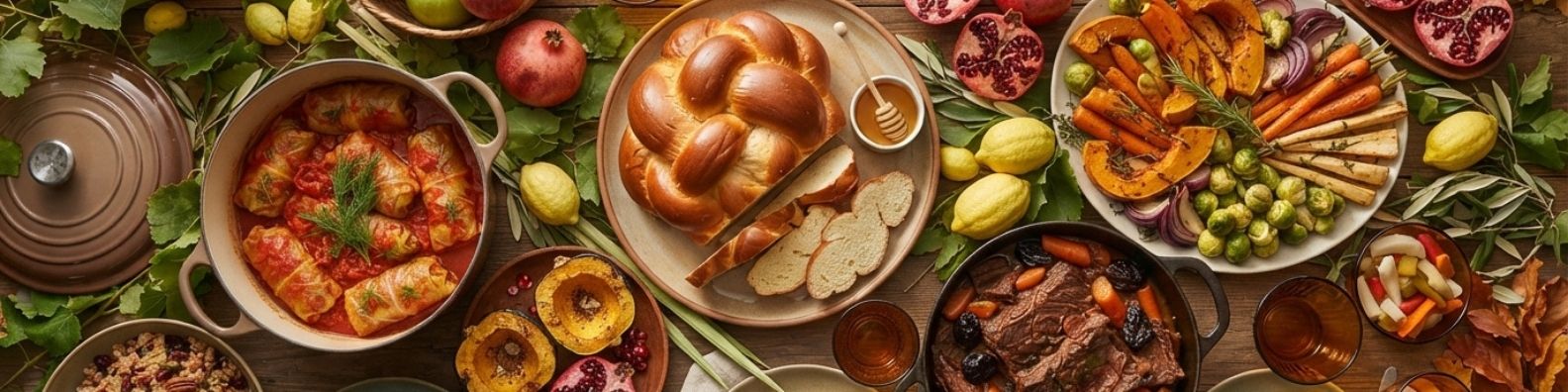
Pronounced: huh-LISH-kez (Yiddish) — also known as praakes, galuptzi, or cabbage rolls
What it is
Large cabbage leaves blanched until pliable, wrapped around a filling of seasoned minced beef and rice, then slow-cooked in a sweet-and-sour tomato sauce for several hours until the filling is tender and the sauce has thickened to a rich, sticky glaze.
Why Sukkot?
Stuffed cabbage uses the harvest — cabbage, beef, rice — and the slow cooking means it can be prepared before Yom Tov and reheated in the sukkah without any fuss. It is also a dish that travels well and tastes better the next day, making it ideal for the week of Sukkot meals. The sweet-and-sour sauce — tinned tomatoes, brown sugar or honey, lemon juice, sometimes raisins — is the defining characteristic of the Ashkenazi version.
The tradition
Holishkes are the single most iconic Sukkot food in Ashkenazi Jewish cooking. The recipe that produces the holishkes that taste like the Sukkot of your childhood is, as with all the best Jewish dishes, a family secret — every family has their own proportions of sweet to sour, their own additions to the sauce, their own memories attached to the smell.
When is it served?
Every Yom Tov meal of Sukkot — Friday night, Saturday lunch, the second days (outside of Israel). Holishkes appear on Shemini Atzeret and Simchat Torah tables too.
💡 Tip: Make double the quantity on the first day. Holishkes improve significantly after sitting in their sauce overnight, and having a pan ready for the second Yom Tov meal is one of the great reliefs of Sukkot cooking. |
What it is
Bell peppers with their tops removed and seeds cleared, filled with a seasoned mixture of minced beef, rice, and onion, then baked or braised in tomato sauce until the peppers are tender and the filling is cooked through.
The two traditions
Both Ashkenazi and Sephardi families make stuffed peppers for Sukkot, though the fillings and cooking methods differ. The Ashkenazi version uses the same sweet-and-sour tomato sauce as holishkes. The Sephardi version often uses a spiced tomato sauce with cinnamon, allspice, and sometimes a small amount of dried mint, producing something altogether more fragrant and complex. The different colour peppers — red, yellow, orange — make for a visually striking tray that suits the abundance of a Sukkot table.
When is it served?
Throughout Sukkot, often served alongside holishkes as a mixed tray of stuffed vegetables.
Pronounced: YAP-rak (Turkish) | DOL-ma | MAH-shee (Arabic)
What it is
Grape vine leaves (either fresh or preserved in brine) wrapped tightly around a filling of rice, minced lamb or beef, herbs, and spices, then cooked in a lemony broth until tender.
The Sephardi Sukkot table
The Sephardi Sukkot table also frequently features stuffed courgettes (mahshi kousa), stuffed aubergines, and stuffed onion layers — an entire category of stuffed dishes that turns the holiday’s harvest theme into a cooking philosophy. Where Ashkenazi Jews wrap minced beef in cabbage leaves and cook it in tomato sauce, Sephardi and Mizrahi families wrap spiced rice and meat in grape leaves and cook them in a bright, lemony broth. The result is completely different in flavour and appearance but identical in symbolic logic.
When is it served?
Throughout Sukkot in Sephardi households. Often served at room temperature, which makes them excellent for the sukkah where temperature management is challenging.
What it is
A clear, golden broth made from a whole chicken simmered for hours with root vegetables — carrots, parsnip, onion, celery — served with kneidlach (matzo balls), lokshen (egg noodles), or kreplach floating in the bowl.
Why Sukkot?
If chicken soup is Jewish penicillin at any time of year, in the sukkah in October it becomes something close to essential. A wide bowl of clear golden broth, a round fluffy kneidel floating in it, a slice of carrot — this is what warms a Sukkot table when the temperature drops after dark and the candles are flickering in the wind. At Sukkot, chicken soup is often served with kreplach rather than or alongside kneidlach.
💡 Tip: Make the soup a day or two ahead of Yom Tov. The flavour deepens overnight and the fat rises to the surface and can be skimmed off, leaving a cleaner, clearer broth. Reheat gently so the broth does not cloud. |
What it is
Small triangular or square pasta parcels filled with seasoned minced beef, boiled and then either served in chicken soup or pan-fried in chicken fat until golden and crispy on the outside.
Why Hoshana Rabbah?
Hoshana Rabbah (Tuesday 20 October in 2026) is the last of the High Holiday period — the day on which tradition holds that the divine judgement sealed on Yom Kippur is finally delivered. Kreplach, with their hidden filling inside a plain pasta wrapper, are associated in kabbalistic tradition with concealment — the hidden judgement, the mercy inside the severity.
The three occasions
Kreplach are eaten on three occasions in the Jewish year when the theme of concealment appears: Erev Yom Kippur, Hoshana Rabbah, and Purim (where hamantaschen carry a concealed filling). On all three occasions, something is hidden. Pan-fried kreplach — cooked briefly in soup first, then crisped in a hot pan — develop a golden crust while the interior remains tender, producing one of the most satisfying textures in Jewish cooking.
When is it served?
Hoshana Rabbah specifically. Some families also serve kreplach on Erev Yom Kippur.
What it is
The round spiral challah introduced for Rosh Hashanah continues to appear on the Shabbat and Yom Tov table throughout Tishrei – through Rosh Hashanah, Yom Kippur, Sukkot, and into Shemini Atzeret. The round shape, representing the cycle of the year with no beginning and no end, is maintained because the Jewish calendar is still inside the High Holiday and festival season.
Custom and tradition
Some families continue using round challahs through all of Sukkot; others switch back to the braided loaf partway through. There is no single ruling it is a matter of family custom. At Sukkot, challah is sometimes decorated with symbols of the arba minim (four species) as braided decorations in the dough.
What it is
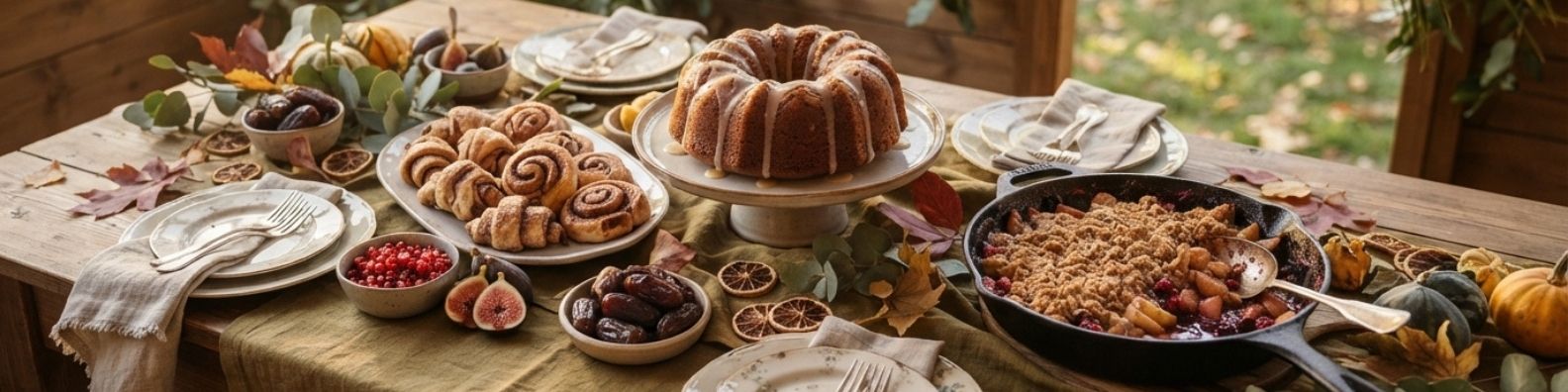
A dense, moist cake made with fresh apples, cinnamon, oil (rather than butter, making it pareve and suitable for meat meals), and a small amount of honey. Baked until the apples are completely soft and the top is caramelised and slightly crisp.
Why apple cake for Sukkot?
The apple harvest in Britain peaks in September and October, which means Sukkot falls at exactly the right moment. A properly made pareve apple cake — moist from the apple itself, warmly spiced with cinnamon and sometimes a small amount of ginger — is as autumnal as the season that surrounds the sukkah. Apple cake at Sukkot also carries forward the apple-and-honey symbolism of Rosh Hashanah.
Tip: Apple cake keeps exceptionally well for three to four days, making it an ideal first-day bake that carries through the whole week of Sukkot. |
What it is
The etrog (citron) — one of the four species held and shaken during Sukkot — is a thick-skinned, fragrant citrus fruit used during the festival itself. After Sukkot ends, the etrog is often used to make jam, etrog liqueur, or candied etrog peel rather than being discarded.
The tradition
Etrog jam is made from the pith and peel of the citron, which is considerably thicker than that of a lemon or orange. The pith must be blanched several times to remove bitterness, but the resulting jam has a unique floral, slightly herbal sweetness quite different from any other citrus preserve. It is traditionally eaten on Shabbat through the winter as a reminder of Sukkot. Etrog liqueur — made by macerating the etrog in vodka or grain alcohol with sugar — is another common post-Sukkot project.
When is it made?
After Sukkot ends, using the etrog from the arba minim set. The making of etrog jam is itself a continuation of the Sukkot mitzvah into everyday life.
What it is
The slow-cooked Shabbat stew – beef brisket, potatoes, beans, barley, and onion – assembled before Shabbat and cooked overnight at a low temperature, ready for Saturday lunch without any cooking on the day itself.
Cholent in the sukkah
Sukkot always contains a Shabbat – Shabbat Chol HaMoed, the intermediate Shabbat of the festival, which falls on Saturday 17 October in 2026. And where there is Shabbat, there is cholent. Eating cholent in the sukkah on a cold October Saturday – the steam rising from the pot, the schach above, the lulav and etrog on the table – is a quintessentially Sukkot experience.
The guide above leans primarily toward Ashkenazi traditions because they are the majority tradition among UK Jewish communities, but the Sephardi Sukkot table deserves its own moment.
In Sephardi households — whether Moroccan, Turkish, Syrian, Iraqi, or Yemenite — Sukkot food is built around the arba minim and the harvest symbolism of the holiday in a particularly direct way. Rice dishes are central, stuffed vegetables are more varied, and the spicing is fragrant with cinnamon, allspice, cumin, and turmeric.
The Moroccan Sukkot table often features a couscous with seven vegetables — a dish that maps directly onto the seven days of Sukkot. Syrian Jews often make a Sukkot kibbeh that does not appear at any other time of year. Iraqi Jews make a rice-stuffed quince dish using the quince harvest at its autumn peak.
Sukkot in the UK presents a specific set of practical challenges. Here are the ones that matter most for food planning.
Warmth first. In October in Britain, the temperature after dark can drop to 8–10°C. Every dish you serve in the sukkah should be capable of being eaten warm. Soups, stews, stuffed vegetables in their sauce, cholent — all work. Cold salads as the main dish do not, unless the afternoon is unusually warm.
Make ahead. The major Sukkot Yom Tov meals all benefit from dishes made before Yom Tov began and only needing reheating. Holishkes on day four taste better than holishkes on day one. Cooking ahead is not a shortcut — it is the correct approach to Sukkot food.
Serve family-style. The sukkah table works best when dishes are served in the centre and people help themselves. Big pots, serving dishes, ladles, and tongs are the correct equipment. Individual plated portions work against the communal spirit of the festival.
Hot drinks are structural. A strong cup of tea with a slice of honey cake. Coffee with rugelach. Hot apple cider with cinnamon. These make sitting in the sukkah on a Tuesday night in October feel like a celebration.
What do Jewish people eat on Sukkot?
The most traditional Sukkot foods are stuffed vegetables — holishkes (stuffed cabbage) in Ashkenazi tradition and mahshi (stuffed peppers, courgettes, and grape leaves) in Sephardi tradition. Beyond stuffed vegetables, Sukkot meals typically include chicken soup (often with kreplach on Hoshana Rabbah), slow-cooked meat dishes, round challah, and autumn desserts such as apple cake and honey cake. Cholent is served at Shabbat Chol HaMoed — the Shabbat that falls within Sukkot.
Why are stuffed vegetables the traditional food of Sukkot?
Stuffed vegetables are associated with Sukkot because they embody the themes of the holiday: the harvest (using the season’s vegetables), abundance (a filling inside a wrapper, representing fullness and gratitude), and the structure of the sukkah itself (an outer layer protecting a warm interior). The tradition spans almost every Jewish community worldwide — Ashkenazi, Sephardi, and Mizrahi — though the specific vegetables and fillings differ by community.
What is kreplach and why is it eaten on Hoshana Rabbah?
Kreplach are small filled pasta parcels — similar to tortellini — stuffed with seasoned minced beef and either served in chicken soup or pan-fried until golden. They are traditionally eaten on Hoshana Rabbah (the seventh and final day of Sukkot) because kabbalistic tradition associates the concealed filling inside the plain dough with the theme of concealment — the final divine judgement of the year, delivered on Hoshana Rabbah, is hidden inside the day just as the filling is hidden inside the pasta.
What do you do with the etrog after Sukkot?
The etrog (citron), one of the four species used during Sukkot, is traditionally made into etrog jam, etrog liqueur, or candied etrog peel after the festival ends. Rather than discarding it, families extend the holiness of the object into everyday use — etrog jam eaten on Shabbat through the winter is a way of carrying the memory of Sukkot forward into the year.
What challah is served at Sukkot?
Round challah — the spiral-shaped challah introduced for Rosh Hashanah — continues to appear on the Sukkot table throughout the month of Tishrei. The round shape, representing the cycle of the year with no beginning and no end, is maintained throughout the High Holiday and festival season. Some families continue with round challah through all of Sukkot; others switch back to braided challah partway through. Both are correct — it is a matter of family and community custom.
🔗 Shop kosher challah — sabeny.co.uk/kosher-shop/bakery/
Is Sukkot food different from Rosh Hashanah food?
Yes, though there is overlap. Both Rosh Hashanah and Sukkot feature round challah, honey cake, and slow-cooked meat dishes. Sukkot is distinct in its emphasis on stuffed vegetables (particularly holishkes and mahshi), and in the specific Hoshana Rabbah dish of kreplach. Sukkot food also tends to be heartier and more warming than Rosh Hashanah food, reflecting the October climate and the week-long nature of the festival.
Can you serve food in the sukkah in cold weather?
Yes — in fact, serving warm food in the sukkah is the correct approach to Sukkot in the UK and other northern European climates. Soups, stews, slow-cooked dishes, and hot drinks are ideal. The tradition of eating in the sukkah applies regardless of the weather (with exceptions for genuine health risks), and preparing warming, substantial food is both halachically appropriate and practically sensible for a British October.
Sabeny delivers certified kosher food and Sukkot essentials across the UK – challah, deli-ready dishes for the sukkah, rugelach, honey cake, and the full range of kosher products for every Yom Tov meal.
Already have an account? Sign in
