

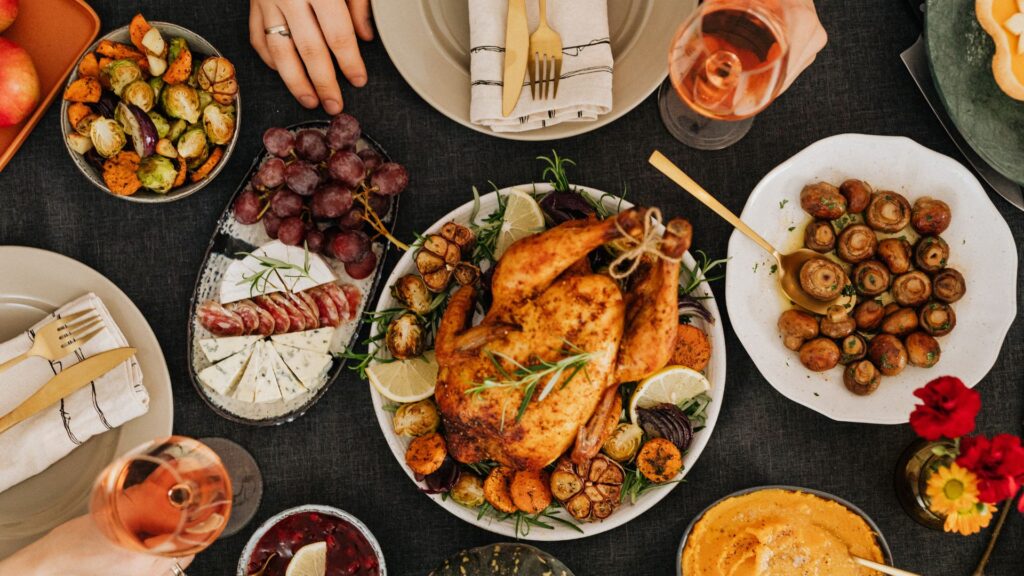
Keeping kosher is one of the most distinctive practices of Jewish life,and one of the most misunderstood. Ask someone who does not keep kosher what it means and they will usually say something about pork and shellfish. Ask someone who does keep kosher and they will tell you it is considerably more than that: a complete framework for how food is chosen, prepared, cooked, and eaten, running through every meal of every day.
This guide is for anyone starting from the beginning. Whether you have just decided to start keeping kosher, are exploring Jewish practice for the first time, have married into a Jewish family and want to understand what your in-laws’ kitchen involves, or are simply curious about what the kosher rules actually are, this is the complete, honest, practical answer.
The word kosher comes from the Hebrew kasher (כשר), meaning fit or proper. To keep kosher is to observe kashrut, the body of Jewish dietary law that specifies which foods are permitted, how they must be prepared, and how they must be eaten. Kashrut is one of the oldest continuously observed sets of food rules in human history, dating back to the Torah and refined through thousands of years of rabbinic interpretation.
Keeping kosher is not a health regime, a cultural preference, or a loose set of suggestions. It is a religious obligation, a set of laws derived from the Torah and Jewish legal tradition that observant Jews follow as part of their religious practice. The reasons given for kashrut vary: some emphasise the discipline and mindfulness it brings to eating; others the connection to Jewish identity and community; others the ethical dimensions of specific laws (particularly around animal welfare in slaughter). Most observant Jews keep kosher simply because it is a mitzvah, a divine commandment, regardless of the reasons behind it.
It is also worth saying at the outset: there are many levels of kashrut observance, and Jewish communities differ in how strictly they apply specific rules. What follows is a comprehensive overview of the laws as traditionally practised in mainstream Orthodox communities. Some Reform, Liberal, and Masorti Jews observe kashrut differently or more loosely. If you are keeping kosher within a specific community, speak to your rabbi for guidance that is specific to that community’s standards.
Kashrut rests on several foundational principles. Understanding these principles makes the specific rules much easier to follow, because most of them flow logically from the same core ideas.
The Torah specifies which animals may be eaten. For land animals, the animal must have split hooves and chew its cud — both conditions must be met. Cattle, sheep, goats, and deer are permitted. Pigs have split hooves but do not chew the cud — they are forbidden. Camels chew the cud but do not have split hooves — also forbidden. This is why pork is not kosher.
For fish and seafood, the animal must have both fins and scales. Salmon, tuna, cod, herring, and trout are all kosher. Prawns, lobster, crab, mussels, and other shellfish have no scales — they are not kosher. Swordfish and sturgeon are disputed between authorities.
For birds, the Torah lists specific forbidden species (birds of prey and certain others). Chicken, turkey, duck, goose, and pigeon are all permitted. The eggs of kosher birds are permitted, provided they contain no blood spot (a blood spot renders an egg non-kosher — eggs should be checked before use).
Insects are generally forbidden. This has significant practical implications: leafy vegetables such as lettuce, broccoli, and asparagus must be carefully checked and washed to ensure no insects remain. Many strictly observant households use a light box to inspect leaves. Some communities rely on pre-checked, certified insect-free produce, which is increasingly available from kosher suppliers.
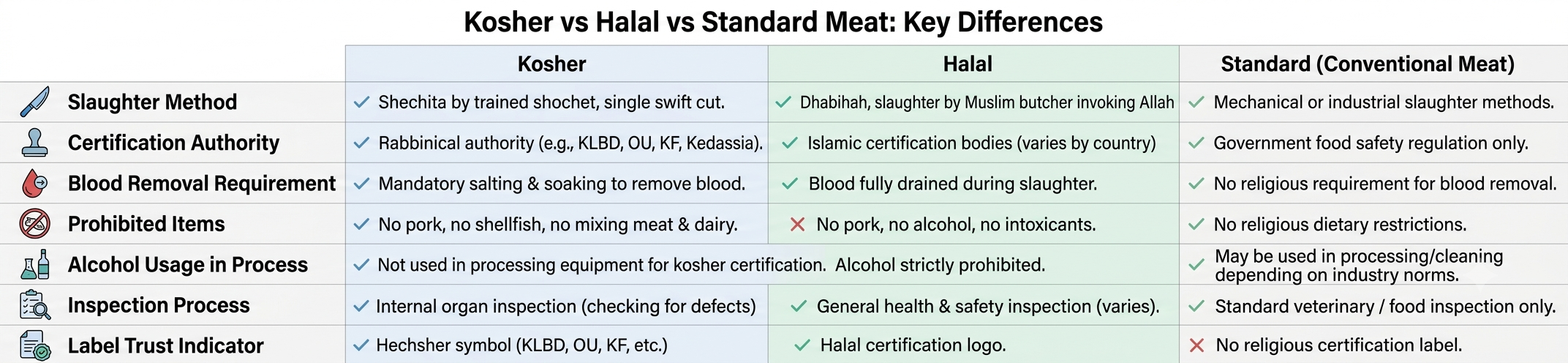
Even a permitted animal must be slaughtered in the correct way to be kosher. The method of kosher slaughter is called shechita and must be performed by a qualified, trained, and God-fearing Jewish slaughterer called a shochet. The shochet uses an extremely sharp, smooth blade (chalef) to make a single, swift, uninterrupted cut across the throat, severing the oesophagus and trachea and the major blood vessels in one motion. This must be done without any hesitation, pressure, or pause.
After slaughter, the animal is inspected by a bodek (inspector) to ensure the animal was healthy and free from certain defects that would render it non-kosher (treif or treifah). The lungs, in particular, must be smooth — adhesions (sirchot) may or may not render the animal forbidden depending on their nature and the community’s standard. Meat from animals that pass inspection is certified as glatt (smooth) if the lungs are perfectly clear – a higher standard increasingly adopted by mainstream Orthodox communities.
Shechita is performed under rabbinical supervision. Kosher meat in the UK is certified by the KLBD, the Manchester Beth Din, or Kedassia, and the packaging will carry the relevant certification symbol.
The Torah prohibits the consumption of blood. After slaughter, kosher meat must be kashered – a process of drawing out the remaining blood through salting (melicha) or, for liver, broiling directly over an open flame. The meat is soaked in cold water for 30 minutes, then covered in coarse salt and left for an hour to draw out the blood, then rinsed thoroughly. Liver contains so much blood that it cannot be kashered by salting alone — it must be grilled directly over fire.
Most kosher meat sold today has already been kashered by the butcher or supplier. If you buy from a certified kosher butcher or supermarket like Sabeny, the meat has been kashered before sale. If you buy from a source where this is not clear, check. Unkashered kosher-certified meat must be kashered within 72 hours of slaughter, before it is frozen, or within 72 hours of defrosting.
This is the rule that most often surprises people who are new to kashrut: it is forbidden to cook or eat meat and dairy together. The prohibition comes from the verse in the Torah ‘do not boil a kid in its mother’s milk’, which appears three times and is interpreted by Jewish law as forbidding the cooking, eating, and benefiting from a mixture of meat and dairy.
In practical terms, this means: you cannot have a cheeseburger, you cannot add cream to a meat sauce, you cannot eat butter with a steak. More than that: meat and dairy must be kept completely separate in the kitchen. Separate pots and pans, separate crockery, separate cutlery, separate chopping boards, separate sponges. Many kosher households colour-code their kitchen equipment — red for meat, blue for dairy, for example.
After eating meat, there is a waiting period before dairy may be consumed. The standard Ashkenazi custom is to wait six hours. Some Sephardi communities wait three hours. After eating hard cheese, some authorities also require a waiting period before meat. After dairy, most Ashkenazi authorities require only washing the mouth and eating something neutral (such as bread) before eating meat — though hard cheese requires longer.
The third category is pareve — food that is neither meat nor dairy. Fish, eggs, fruit, vegetables, and most grains are pareve. Pareve food can be eaten with either a meat or a dairy meal. However, if a pareve item is cooked in a meat pot, it takes on the status of meat and cannot be eaten with dairy — and vice versa.
Certain animal fats called chelev — the hard, white fat around the internal organs of cattle, sheep, and goats — are forbidden even from otherwise kosher animals. This fat must be removed by the butcher before sale. The sciatic nerve (gid hanasheh) of the hindquarters is also forbidden, based on the biblical story of Jacob’s struggle with the angel. Removing the sciatic nerve is a complex process called nikkur (porging). In most Western countries including the UK, the hindquarters of cattle are sold into the non-kosher market rather than being porged, which is why you will typically not find kosher sirloin, fillet, or rump steak in the UK. Kosher beef tends to come from the forequarters
The kosher kitchen is the physical expression of the laws of kashrut. Setting one up from scratch is the moment at which the theoretical laws become concrete daily practice. Here is what it involves.
The fundamental requirement of a kosher kitchen is complete separation between meat and dairy equipment. This means two sets of: pots and pans, crockery (plates, bowls, serving dishes), cutlery (knives, forks, spoons), cooking utensils (wooden spoons, spatulas, ladles), chopping boards, washing-up bowls, and ideally separate drying racks and sponges.
Many kosher kitchens colour-code their equipment from the start to avoid confusion. A common system: red handles or dots for meat, blue for dairy. Some families use labels. Some keep the two sets in entirely separate cupboards or even separate sections of the kitchen.
A third category of equipment – pareve – is used for food that is neither meat nor dairy. Some kitchens have a third colour for pareve utensils, particularly knives used for cutting vegetables.
Ideally, a fully kosher kitchen has two separate ovens – one for meat, one for dairy. In practice, many households have one oven which is designated as either meat or dairy and used exclusively for that category. Some authorities permit a single oven to be used for both meat and dairy at different times, with thorough cleaning and a waiting period between uses, but this requires specific rabbinical guidance.
The hob is generally treated similarly. Many kosher kitchens have a hob designated meat on one side and dairy on the other, with dedicated burners for each. Others use one hob for both, with care taken never to use the same ring for meat and dairy simultaneously.
The sink presents a similar question. Some kosher kitchens have two sinks – one for meat, one for dairy. Where only one sink is available, a common approach is to use separate washing-up bowls inside the sink, one for meat and one for dairy, so the crockery never sits directly in a sink that has been used for the other category.
If you are taking over an existing kitchen or making a kitchen kosher for the first time, most equipment needs to be kashered – purged of any non-kosher status it may have absorbed through previous use. The method of kashering depends on how the equipment is normally used:
Kashering a kitchen for the first time is a process best done with rabbinical guidance. Your local rabbi or the KLBD can advise on the specific requirements for your kitchen and equipment.
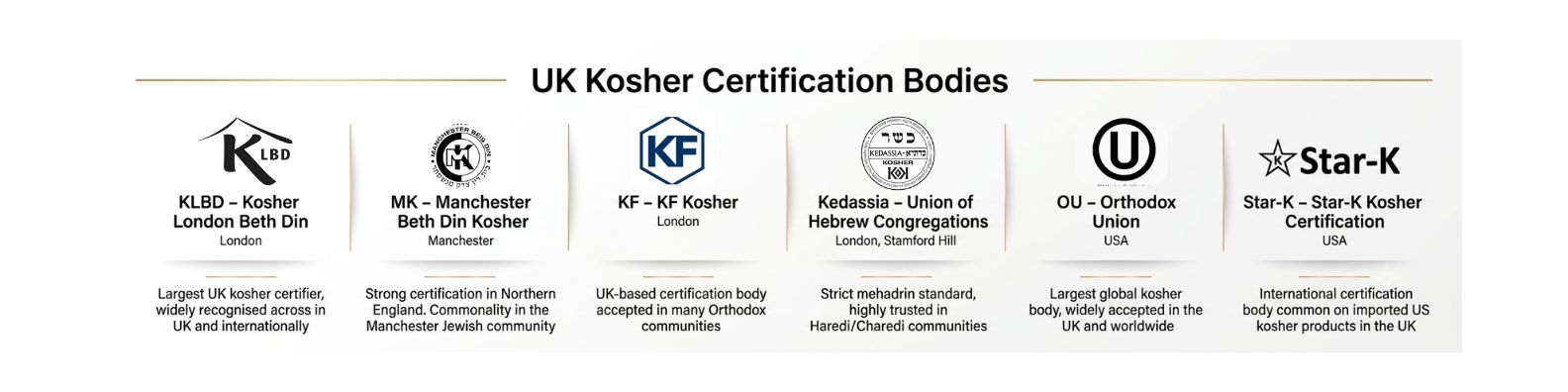
In a kosher kitchen, every packaged, processed, or manufactured product must carry a recognised kosher certification symbol. Fresh, unprocessed fruit and vegetables generally do not require certification (though leafy vegetables must be checked for insects). Fresh fish purchased from a reliable source with clearly visible fins and scales may not require certification, though pre-processed fish products do.
For a comprehensive guide to kosher symbols – KLBD, OU, Kedassia, Star-K, and more – see Sabeny’s guide to kosher certification symbols. Click here.
Keeping kosher in the UK has become significantly easier over the past two decades. Kosher-certified products are now widely available in mainstream supermarkets -Marks & Spencer, Waitrose, Tesco, Sainsbury’s, and others all stock kosher products – and a growing number of specialist kosher retailers and online supermarkets serve Jewish communities across the country.
When shopping in a mainstream supermarket, the key is to look for the certification symbol on every product. The KLBD symbol (Kosher London Beth Din) is the most commonly found certification in UK supermarkets. The OU symbol (Orthodox Union, the American standard) is found on many imported products. A full guide to these symbols and what they mean is in Sabeny’s kosher certification guide.
Not everything in the supermarket with a recognisable brand is kosher. Many popular products — from breakfast cereals to chocolate bars — have kosher-certified variants but also non-certified variants. The symbol on the packaging is the only reliable indicator. Do not assume.
Fresh kosher meat is not available in mainstream UK supermarkets. For kosher meat, you need either a certified kosher butcher or a kosher food delivery service. In London, certified kosher butchers are found in Golders Green, Hendon, Edgware, and Stamford Hill. In Manchester, kosher butchers are concentrated in the Prestwich area. In Gateshead, Borehamwood, and other Jewish communities, local kosher suppliers exist.
Outside these communities, the most practical option is ordering kosher meat online from a certified kosher supplier. Sabeny delivers certified kosher meat, poultry, and deli products to every UK postcode. Click here to shop.
Dairy products present specific kashrut considerations. Milk, butter, and cheese from a kosher animal are potentially kosher, but Jewish law requires that certain dairy products be produced under Jewish supervision. Chalav Yisrael (חלב ישראל) refers to milk that has been supervised by a Jew from milking onwards — a standard observed by many strictly Charedi communities. Most mainstream UK Orthodox communities accept regular certified kosher dairy (chalav stam) without this additional requirement.
Cheese presents a further requirement. Most hard cheeses are made using rennet, an enzyme traditionally derived from animal stomach lining. For cheese to be kosher, the rennet must be from a kosher source or be a microbial/vegetable rennet, and the cheese must be produced under rabbinical supervision. This requirement is called gevinat Yisrael for hard cheeses. Most kosher soft cheeses and cream cheeses are readily available with certification.
Bread from a Jewish-owned and kosher-certified bakery carries the certification of that bakery. There is also a concept called pas Yisrael — bread baked by a Jew (or with Jewish involvement in the baking process). Many strictly observant communities prefer pas Yisrael bread, particularly for Shabbat. Most certified kosher bakeries in the UK produce pas Yisrael bread. Commercially produced bread from mainstream bakeries may be certified kosher but will not be pas Yisrael.
Sabeny stocks freshly baked challah, honey cake, rugelach, and a range of other certified kosher bakery products, all certified under recognised supervision. Shop for kosher bakery items here.
On Shabbat (the Jewish Sabbath, from Friday sunset to Saturday night), cooking is not permitted. This does not mean the food is different, but it means all cooking must be done before Shabbat begins. Food that is already cooked may be kept warm on a blech (a metal sheet covering the hob burner) or in an oven set before Shabbat. Modern solutions include programmable crockpots and slow cookers, which can be set before Shabbat and left to keep food warm without any adjustment during the Sabbath.
On Yom Tov (Jewish festival days such as Rosh Hashanah, Passover, and Sukkot), cooking is generally permitted — but only from a pre-existing flame, and not creating a new fire from scratch. Electric cooking is not permitted on Yom Tov under most Orthodox opinions. The detailed laws of cooking on Yom Tov are extensive — consult your rabbi for specific guidance. Shop for Shabbat – Click here
Once a year, at Passover (Pesach), an additional set of restrictions applies on top of the regular kashrut laws. During the eight days of Passover (seven days in Israel), leavened grain products — chametz — are completely forbidden. Not just forbidden to eat, but forbidden to own or benefit from. Before Passover, the entire home must be thoroughly searched and cleaned for chametz, and any chametz that is found must be burned, sold, or disposed of.
The scope of chametz is significant: bread, pasta, most breakfast cereals, most biscuits, beer, whisky, and anything made from wheat, barley, oats, rye, or spelt that has been leavened. In their place, Passover uses matzah — unleavened bread made from flour and water mixed and baked within 18 minutes to prevent any leavening.
Ashkenazi Jews traditionally also avoid kitniyot — a category that includes legumes, rice, corn, peas, and lentils — during Passover, though this custom is not observed by Sephardi Jews. In recent years, some Ashkenazi authorities have permitted kitniyot for health reasons or by community decision.
Passover requires separate, dedicated Passover dishes and utensils that have never been used for chametz, or that have been kashered specifically for Passover. Many families store their Passover crockery separately and bring it out exclusively for the festival. Shop for Passover by clicking here.
Eating out when keeping kosher requires care, because the vast majority of restaurants in the UK are not certified kosher. The options are:
Sabeny stocks everything you need to keep a kosher kitchen — certified kosher meat, dairy, bakery, and grocery delivered to every UK postcode. Free delivery on orders over £85. Shop at sabeny.com.
Already have an account? Sign in
