

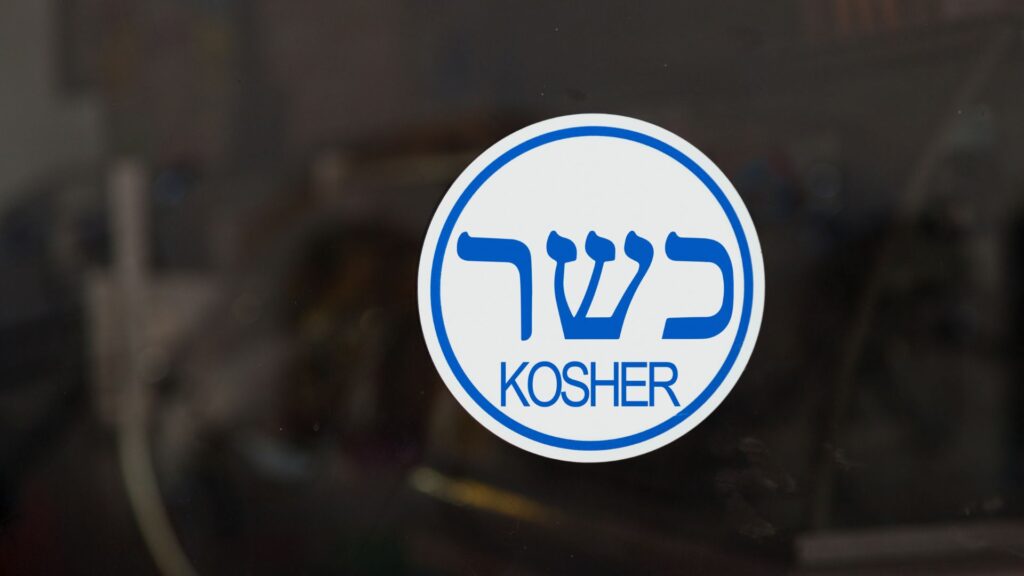
Walk into any supermarket and you will find kosher symbols on hundreds of products, small circular marks, letters, and logos stamped on packaging from breakfast cereals to bottled water. But what do they actually mean? Which ones are recognised? And when you see three different symbols on three different products, how do you know which one to trust?
This guide explains everything: what kosher certification means, who provides it in the UK and worldwide, what each major symbol represents, which marks are accepted by different Jewish communities, and how to check whether a product is genuinely certified kosher. Whether you are keeping kosher yourself, buying for a Jewish household, or sourcing certified products for an event or workplace, this is the guide that answers every question.
The word kosher comes from the Hebrew כשר (kasher), meaning fit or proper. In the context of food, it means food that meets the requirements of Jewish dietary law, known as kashrut. Kosher certification is the process by which a recognised rabbinical authority inspects a product, its ingredients, and its production process to verify that it complies with these requirements.
Kosher certification is not simply a blessing applied to a product. It involves a thorough review of every ingredient in a product, the equipment used to make it, the cleaning procedures between production runs, and, for meat and poultry, the entire slaughter and preparation process. A product cannot carry a kosher symbol simply because it happens to contain kosher ingredients: the entire production process must be certified.
The kosher laws themselves cover several key areas: the prohibition on pork and shellfish; the requirement that permitted animals be slaughtered in a specific way (shechita); the complete separation of meat and dairy in both cooking and eating; the prohibition on eating insects; and specific rules about wine and grape products, cheese, bread, and a range of other foods. The details are extensive, but the certification symbol on a product is the shorthand that tells you a qualified rabbinical authority has checked that all of them are met.
Kosher certification is provided by rabbinical authorities, organisations staffed by rabbis who have been trained in Jewish dietary law and are qualified to inspect and certify food production. These organisations are commonly called hechsher authorities (a hechsher being the kosher certification itself) or simply kashrut authorities.
There are dozens of kosher certification bodies worldwide, ranging from small community-level authorities to large international organisations that certify hundreds of thousands of products. In the UK, the two primary authorities are the KLBD (Kosher London Beth Din) and the MK (Manchester Beth Din). Internationally, the OU (Orthodox Union) in New York is the largest and most widely recognised. Different Jewish communities may accept different certifications, which is why understanding which symbol comes from which authority matters
Below is a comprehensive guide to every major kosher certification symbol you are likely to encounter on products sold in the UK.
The KLBD is the largest and most widely recognised kosher certification authority in the UK, operating under the London Beth Din (the rabbinical court of the United Synagogue). The KLBD symbol — a stylised design incorporating the letters KLBD — appears on thousands of products sold in UK supermarkets, kosher food shops, and online.
The KLBD certifies a wide range of products across all categories: fresh and frozen meat and poultry, dairy products, bakery, confectionery, processed foods, wines and spirits, cosmetics, and pharmaceutical products. It operates mashgichim (kosher supervisors) in production facilities to monitor compliance. The KLBD also maintains a searchable online database (klbd.com) where consumers can verify whether a specific product or brand is certified.
KLBD at a glance |
|
Full name | Kosher London Beth Din |
Operated by | The London Beth Din / United Synagogue |
Symbol appears as | ‘KLBD’ mark — various approved designs |
UK supermarkets | Widely found in Marks & Spencer, Waitrose, Sainsbury’s, Tesco, Asda, Morrisons |
Accepted by | Mainstream Orthodox and United Synagogue communities throughout the UK |
Verify at |
The Manchester Beth Din’s kashrus division is the second major UK kosher certification authority. The MK certifies products produced in the North of England and increasingly operates across the UK. It is particularly well-known for its certification of meat products in Manchester and the surrounding region, and for its close links with the Manchester and Gateshead Jewish communities.
The MK symbol is accepted by mainstream Orthodox communities throughout the UK, including United Synagogue communities. Some more strictly observant communities in Manchester and Gateshead may prefer MK certification over KLBD for products produced in the North.
MK at a glance |
|
Full name | Manchester Beth Din — Kashrus Division |
Symbol appears as | ‘MK’ mark |
Accepted by | Orthodox communities UK-wide; particularly trusted in Manchester and Gateshead |
Verify at | mbd.org.uk |
The KF (Kosher Federation) is a UK-based kosher certification authority that was established to provide an alternative to the KLBD, particularly for businesses seeking more flexible or cost-effective certification. The KF symbol appears on a range of UK products and is accepted by many mainstream Orthodox communities.
It is worth noting that acceptance of KF varies by community. While the KF is recognised by many UK Orthodox communities, some synagogues and individuals may only accept KLBD or MK certification. If you are buying for guests with strict kashrut requirements, it is worth checking their specific standards.
KF at a glance |
|
Full name | Kosher Federation |
Symbol appears as | ‘KF’ mark |
Accepted by | Many UK Orthodox communities; check community-specific standards |
Verify at | kosher.org.uk |
Kedassia (the Joint Kashrus Committee) is the strictest major kosher certification authority in the UK, operating under the Adath Yisroel Synagogue and the Union of Orthodox Hebrew Congregations. Kedassia certification is sought and accepted by the most strictly observant Jewish communities in the UK — including many Charedi (ultra-Orthodox) households in Stamford Hill, Salford, Gateshead, and Manchester.
A product carrying the Kedassia symbol meets the most stringent standards of UK kosher certification. Kedassia-certified meat, for example, is under stricter supervision than KLBD-certified meat. Because of this, Kedassia certification is accepted by virtually everyone who observes kashrut — a strictly observant consumer who will only eat Kedassia-certified products will not eat KLBD-only products, but someone who accepts KLBD will typically also accept Kedassia.
Kedassia-certified products are generally available in kosher shops in Stamford Hill, Salford, and Manchester, and from specialist kosher online retailers.
Kedassia at a glance |
|
Full name | Joint Kashrus Committee |
Operated by | Adath Yisroel Synagogue — Union of Orthodox Hebrew Congregations |
Symbol appears as | Kedassia mark — with the Hebrew characters and English text |
Standard level | The strictest mainstream UK certification |
Accepted by | All observant Jewish communities in the UK, including the most strictly Charedi |
Particularly trusted for | Meat, poultry, dairy, and baked goods in Charedi communities |
The OU (Orthodox Union) is the world’s largest kosher certification organisation, based in New York. The OU symbol – a U inside a circle – is the most widely recognised kosher mark in the world and appears on over one million products in 100 countries. In the UK, the OU symbol is frequently found on American-produced products, Israeli products exported to the UK, and UK-produced goods sold to international markets.
The OU symbol appears in several forms. A plain circle-U without any additional letter indicates the product is kosher pareve – it contains neither meat nor dairy. A circle-U followed by the letter D (OU-D) indicates the product is dairy, it contains dairy ingredients or was produced on dairy equipment. A circle-U followed by the letter M (OU-M) indicates the product is meat. A circle-U followed by P (OU-P) indicates the product is kosher for Passover.
OU certification is accepted by virtually all Orthodox Jewish communities worldwide and is considered a gold standard in international kosher certification. In the UK, OU-certified products are treated as equivalent to KLBD certification by most mainstream Orthodox communities.
OU at a glance | |
Full name | Orthodox Union |
Based in | New York, USA |
Symbol appears as | U inside a circle (circle-U) |
OU with D | Dairy |
OU with M | Meat |
OU with P | Kosher for Passover |
OU alone (no letter) | Pareve — neither meat nor dairy |
Scale | Over 1 million products in 100 countries |
Accepted by | All Orthodox communities worldwide; de facto international standard |
Verify at |
Star-K is a major US-based kosher certification organisation based in Baltimore, Maryland. The Star-K symbol – a K inside a star – is widely found on American food products exported to the UK and internationally. Star-K is accepted by mainstream Orthodox communities worldwide and is considered comparable in standard to the OU.
Star-K is particularly well-known for its work in certifying chemicals, pharmaceuticals, and food technology ingredients – many industrial food additives used in products worldwide carry Star-K certification.
Star-K at a glance | |
Full name | Star-K Kosher Certification |
Based in | Baltimore, Maryland, USA |
Symbol appears as | K inside a star |
Accepted by | Orthodox communities worldwide |
Known for | Food technology, chemicals, pharmaceuticals, and American consumer products |
Verify at |
The CRC (Chicago Rabbinical Council) is a major US regional kosher authority whose symbol appears on many American products. The CRC is accepted by mainstream Orthodox communities worldwide and maintains a useful online database of certified products as well as guidance on which other certification agencies it considers acceptable.
In Israel, kosher certification is provided by a range of authorities, the most widely recognised of which is the Chief Rabbinate of Israel. However, many Israeli products — and particularly those sold in the UK — carry certification from one of the Badatz (Beit Din Tzedek) authorities, which are generally considered stricter than the Chief Rabbinate standard.
The most widely known Israeli Badatz certifications in the UK are from the Badatz Edah HaChareidis (considered among the strictest certifications in the world), the Badatz of the Machzike HaDass in Antwerp, and the KAJ (Kehillath Adath Yeshurun) in Germany. Israeli products sold in the UK — including many wines, chocolates, and packaged foods — may carry these symbols.
One of the most important distinctions in kosher law is the separation of meat and dairy. Kosher law (based on the biblical prohibition of ‘boiling a kid in its mother’s milk’) prohibits eating meat and dairy together, cooking them in the same pots, or even consuming them at the same meal. This has significant implications for kosher certification.
Kosher food falls into three categories:
This distinction matters enormously when cooking or serving food. A pareve product can be served at both a meat meal and a dairy meal. A dairy product cannot be served at a meat meal, even if the meat has already been eaten. For someone keeping strictly kosher, this is not a preference, it is a requirement.
In Israel, kosher certification is provided by a range of authorities, the most widely recognised of which is the Chief Rabbinate of Israel. However, many Israeli products, and particularly those sold in the UK, carry certification from one of the Badatz (Beit Din Tzedek) authorities, which are generally considered stricter than the Chief Rabbinate standard.
The most widely known Israeli Badatz certifications in the UK are from the Badatz Edah HaChareidis (considered among the strictest certifications in the world), the Badatz of the Machzike HaDass in Antwerp, and the KAJ (Kehillath Adath Yeshurun) in Germany. Israeli products sold in the UK — including many wines, chocolates, and packaged foods — may carry these symbols.
One of the most important distinctions in kosher law is the separation of meat and dairy. Kosher law (based on the biblical prohibition of ‘boiling a kid in its mother’s milk’) prohibits eating meat and dairy together, cooking them in the same pots, or even consuming them at the same meal. This has significant implications for kosher certification.
Kosher food falls into three categories:
This distinction matters enormously when cooking or serving food. A pareve product can be served at both a meat meal and a dairy meal. A dairy product cannot be served at a meat meal, even if the meat has already been eaten. For someone keeping strictly kosher, this is not a preference, it is a requirement.
During Passover (Pesach), additional restrictions apply. The consumption, ownership, and even presence of chametz — leavened grain products including bread, pasta, beer, and most baked goods — is prohibited. For a product to be kosher for Passover, it must not only be kosher in the normal sense but also be certified free of chametz.
Kosher for Passover certification is indicated by the kosher symbol alongside the word ‘Passover’, ‘P’, or the Hebrew letters for Pesach. Some products are naturally kosher for Passover (fresh fruit and vegetables, for example), while others require specific certification. The standards for Passover certification vary between Ashkenazi and Sephardi communities — notably, Ashkenazi Jews traditionally avoid kitniyot (legumes, rice, corn) during Passover, while Sephardi Jews permit them.
There are several ways to verify whether a product is certified kosher:
Not all kosher certifications are accepted equally by all Jewish communities. Understanding who accepts what is important for anyone buying kosher products for guests with specific requirements.
Community | Typically accepts | Notes |
Mainstream United Synagogue (UK) | KLBD, MK, OU, KF, OK, Star-K | Most widely accepted standard in the UK |
Charedi communities (UK) | Kedassia, KLBD, OU, Badatz | May not accept KF; check specific community standards |
Stamford Hill / North London Charedi | Kedassia, Badatz (Edah), OU | Most will not eat KLBD meat; may accept KLBD on processed food |
Sephardi communities (UK) | KLBD, OU, Sephardi Beth Din | Generally aligned with mainstream Orthodox standards |
Reform / Liberal communities | May have their own guidelines | Kashrut observance varies; check with individual families |
Strictly Charedi / Chasidic | Kedassia, Badatz Edah, KAJ, Machzike HaDass | Highest standard; Badatz Edah considered strictest |
The key principle: a stricter certification is generally accepted by those who follow a less strict standard, but not the reverse. Kedassia-certified products are accepted by virtually everyone. A product certified only by a smaller or lesser-known authority may not be accepted by those with stricter standards. When in doubt, choose the certification with the widest acceptance — KLBD or OU for most situations in the UK.
If a product has no kosher symbol, it is not certified kosher – full stop. A product cannot be assumed to be kosher simply because it appears to contain kosher ingredients, or because the manufacturer claims it meets kosher standards. Kosher certification requires inspection and certification by a qualified rabbinical authority. Without that certification symbol, there is no kosher guarantee.
Some products are naturally kosher – fresh fruit, vegetables, and water are examples where the question of a hechsher is less relevant, though even here community standards vary (the question of insects in leafy vegetables, for example, requires specific checking). For any processed, packaged, or manufactured product, the symbol is essential.
For non-Jewish buyers purchasing for Jewish guests or colleagues: when in doubt, look for the symbol. If there is no symbol, choose a product from a certified kosher retailer rather than assuming.
Wine and grape products occupy a special category in kosher law. According to halacha (Jewish law), wine that has been handled by a non-Jewish person loses its kosher status – a rule that dates from ancient times when wine was used in idolatrous rituals. This means that kosher wine must be produced, bottled, and handled exclusively by Shabbat-observant Jews from grape crushing through to sealing.
There is an exception: yayin mevushal — wine that has been cooked or flash-pasteurised to a certain temperature. Mevushal wine may be handled by non-Jews after the cooking process and retains its kosher status. Most kosher wines for restaurant and event use are mevushal for this reason. The wine’s label will typically indicate whether it is mevushal.
Kosher wine is certified by the same authorities that certify other kosher products — KLBD, OU, Kedassia, and others. Every bottle of kosher wine carries a hechsher. Sabeny stocks a range of certified kosher wines from Israel and internationally, all clearly certified.
Every product sold by Sabeny is certified kosher under a recognised rabbinical authority — primarily KLBD and Kedassia for UK-produced products, and OU or equivalent for international products. Sabeny is a shomer Shabbat company — we do not operate on Shabbat or Jewish holidays. This means that when you buy from Sabeny, every item on the site has been verified for its kosher status before listing. If you have specific questions about the certification of a particular product or need to verify whether it meets the standards of your community, contact us directly and we will confirm.
Browse Sabeny’s full range of certified kosher groceries, bakery, and Yom Tov essentials, delivered to every UK postcode. Every product on the site is certified kosher. Shop at sabeny.com.
Already have an account? Sign in
